


SEO for plastic surgeons is the practice of optimizing a clinic’s website and Google Business Profile to show up in search results for high-intent, location-based procedure queries. It connects prospective patients with surgeon practices through keyword research, local SEO, technical optimization, link building, and other reliable tactics that build visibility and trust online.


People who search for plastic surgeons often take time to compare their options as they look for trustworthy and board-certified expertise. The first place they go for that research is still Google. That’s why we put together this guide on SEO for plastic surgery practices in 2026. You’ll learn proven strategies to improve organic performance and get more online visibility for procedure-driven searches that lead to consultations and bookings.
- The most effective tactics for plastic surgery SEO are local search improvement, technical side enhancement, on-page optimization, and link building.
- A Google Business Profile and reviews often play a deciding role, since they’re usually the first thing people see when searching for a plastic surgery procedure.
- Surgical enhancement websites include lots of visuals and before-and-after images. This can slow pages down, which is why technical SEO is important for keeping load times fast.
- FAQs on procedure pages are not only beneficial for SEO. They also help patients find answers about preparation, recovery, and what to expect.
- Authority signals like surgeon credentials and reviews from previous patients show credibility to Google and help visitors feel confident about choosing your practice.
Why Should Plastic Surgeons Invest in SEO?
SEO is a set of optimization tactics that help put your practice in front of potential patients at the exact moment they show interest. In that sense, it works like a billboard, except it shows up only when someone already wants the service you offer.
That visibility is part of the picture, though SEO for plastic surgery supports much more than that. It also helps you:
- Rank for high-intent procedure searches
- Appear in local results and Google Maps
- Improve user experience and content quality
- Strengthen credibility and reputation signals
More importantly, SEO contributes to long-term growth. Unlike ads, a well-built website continues to attract qualified leads from procedure-driven searches even after the initial work is done.
How E-E-A-T Affects Plastic Surgery SEO
Google applies stricter quality standards to health-related searches because the information can influence decisions about care. Plastic surgery falls into that category, and for that reason, Google pays closer attention to the credibility markers, also known as E-E-A-T, on websites in this industry.
This framework stands for Experience, Expertise, Authoritativeness, and Trustworthiness. For plastic surgeons, this shows up in detailed procedure pages, visible surgeon credentials, accurate office info, as well as patient reviews that show authentic experiences. Those signals influence search rankings, and they affect patient confidence, too.
Top 4 SEO Strategies for Plastic Surgery Websites
SEO for plastic surgeons involves many different tactics. The table below shows what pillars usually fit into an SEO campaign in this industry, from early fixes to ongoing work.
| SEO Pillar | When to Work on It | How Long It Takes | Purpose and Role | Main Components |
| Technical SEO | Start at this stage since all other work depends on it. | From one day for smaller tasks to two or three months for major updates or redesigns. | Makes the website accessible and readable for search engines. | – Site speed and Core Web Vitals – Mobile responsiveness – Secure HTTPS setup – Crawl and index settings – Structured data (schema markup) – Site structure |
| On-Page SEO | Continue once the technical fixes are done. | An ongoing process that develops with the website’s growth. | Helps search engines understand your pages and show them for relevant queries. | – Keyword research and mapping – Optimized titles, meta descriptions, and headings – Service and treatment pages – Internal linking – Image optimization |
| Local SEO | Develop alongside technical optimization. | Around one to two months for setup and consistent maintenance afterward. | Improves visibility in your local area and helps patients find your clinic through Google Maps and regional search results. | – GBP optimization – Consistent NAP details- Local keyword targeting – Reviews and testimonials – Local landing pages |
| Off-Page SEO | Build this stage after the on-page and local work. | Continuous work that establishes long-term authority. | Strengthens your credibility through quality backlinks and collaborations with trusted sources. | – Backlinks from reputable websites – Guest posts and digital PR – Partnerships and local collaborations |
Now that you have a bird’s-eye view of the solid SEO strategies for plastic surgery businesses, let’s look at how you can use each to attract more patients to your practice.
1. Local SEO for Plastic Surgeons
The fastest way for a plastic surgery website to start generating leads is through local SEO. That’s because people searching for aesthetic surgeons are usually looking for options in their vicinity. Google understands this intent and shows them a local map with practices in their area, just like this:
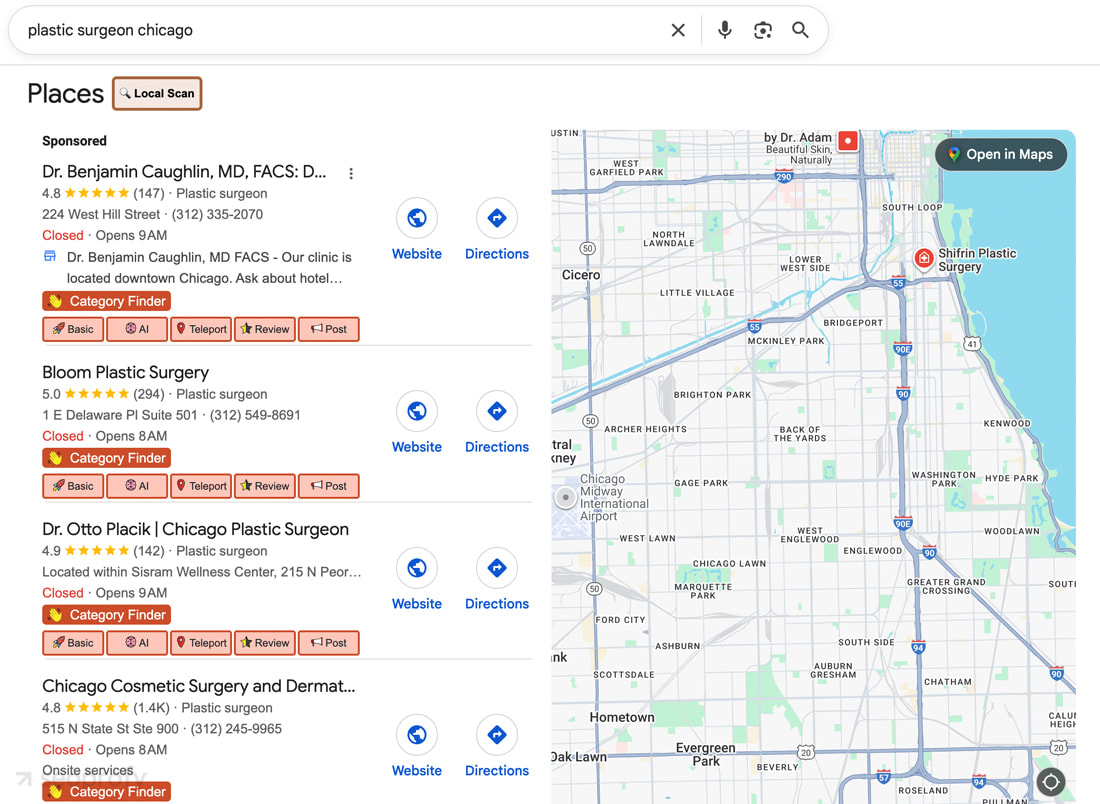
As you might expect, this is also where most clicks go. Users tend to interact with the local pack first before moving on to organic results further down the page. Data shows that around 42% of clicks in local searches go directly to these Google Map listings.
So, your goal with local SEO is to rank in that regional pack and look credible for them to click. Let’s look at how you can do it.
Your Google Business Profile Optimization
Your Google Business Profile does a lot of heavy lifting in local search. For many prospects, it’s the first touchpoint with your practice, well before they visit your site or learn more about your background.
At a minimum, your profile needs to do two things: answer the questions prospective patients already have and show that your practice feels trustworthy. That comes down to how a few sections are set up and maintained.
- Category and services: Your primary category sets the tone for the entire listing. For most practices, Plastic Surgeon fits best. As for the services section, this is where you list what you offer (e.g., rhinoplasty, breast augmentation, facelift, tummy tuck, blepharoplasty, and more).
- Description and photos: You need to have a factual description of your practice, paired with up-to-date photos of the clinic and staff. This helps people learn all the info they need and understand who they’ll be meeting in your practice.
- Posts, Q&A, and updates: These areas often get skipped, though they add useful context. Quick updates, like a new before-and-after gallery or answers to common consultation questions, give people something to engage with directly inside the listing and keep your profile active in the eyes of Google.
Put together, these details help your practice show up with enough context so that once someone sees your listing in search engine results pages, taking the next step feels easy.
Comprehensive Local Landing Pages
In addition to the Business Profile, each of the locations you’re targeting should have its own landing page. These pages support city-specific searches and give potential patients the extra details about each particular office. Here are some best practices on how to write them:
- Use location-based keywords in headings and throughout the copy in a natural way.
- Add specific local details such as the address, parking instructions, public transport options, and consultation hours.
- Mention which doctors work at each location so patients know who they’ll meet.
- Include local review snippets and any awards connected to each office to add credibility and local relevance.
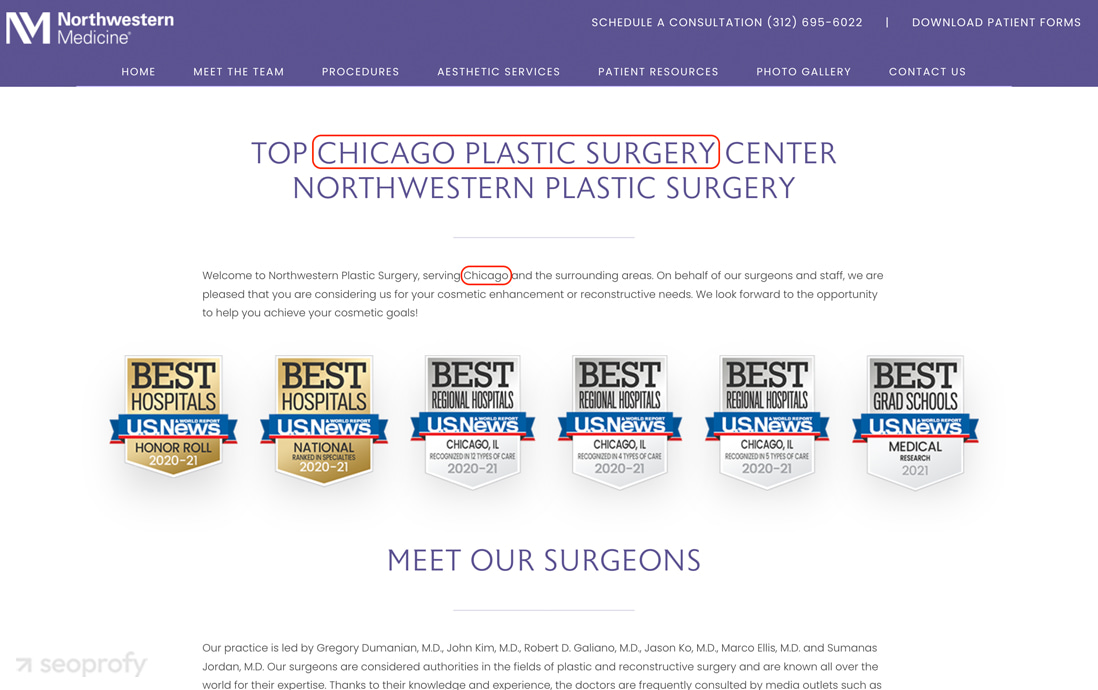
To see how this works in practice, here’s a well-written page from Northwestern Medicine. Notice how the page targets the keyword “Chicago plastic surgery”, shows relevant awards, and also explains which surgeons see patients at that location.
A Solid Reviews Strategy in Place
Reviews are a major local ranking factor and a powerful conversion driver in search engine optimization strategies for plastic surgery. They show Google additional signals through ratings and recency, and they give visitors a way to evaluate the real experiences of your team and your results. Here are a few ways to earn more high‑quality reviews and manage them well:
- Ask for reviews after post-op check-ins or follow-up visits: You can let them scan a QR code and ask for honest feedback.
- Reply to every review: There’s always a chance that you might get a mixed review, so it’s important to reply to all of them and acknowledge what the patient mentioned.
- Look at what keeps coming up in reviews: Sometimes, certain questions get repeated in reviews. It’s a good idea to answer them in your website copy or FAQs, so new patients see those points addressed upfront.
Consistency of Your NAP Details
Google compares your name, address, and phone number across maps and directories before deciding which practices deserve local visibility. When those details don’t match, listings get treated as separate entities rather than one location, which can weaken rankings and create confusion for people. To keep citations consistent:
- Write your address the same way everywhere, including suite numbers
- Use one primary phone number across directories
- Consolidate duplicate listings so they all lead to the same address
These details are worth revisiting regularly, since new directories and duplicates can appear over time.
Local Content that Matches Patient Intent
Local content works best when it reflects the questions people already ask while planning a visit. A few content types that support this particularly well in plastic surgery SEO strategy are:
- Planning pages for visiting patients: Content that explains travel timing, nearby accommodation, recovery windows, and follow-up scheduling.
- Community and local involvement pages: Short recaps of local events or partnerships that show active presence in the area and often earn local links.
- Area and clinic surroundings pages: Pages that introduce the neighborhood around the clinic and nearby medical facilities.
These page types help match local search intent while reinforcing your practice’s presence within a specific geographic area.
Geo-targeted Internal Linking
Internal linking shows Google how your site is structured and which pages belong together. On a plastic surgery site, it also moves visitors from articles into procedure pages, which has a direct impact on time spent on the site and consultations.
The most common way to use this tactic is to link from your blog posts to the relevant procedure page and then on to conversion-oriented pages. For example, here’s how the Chicago Institute of Plastic Surgery does it. They have a post on the benefits of a tummy tuck, where they link directly to their service pages in Chicago.
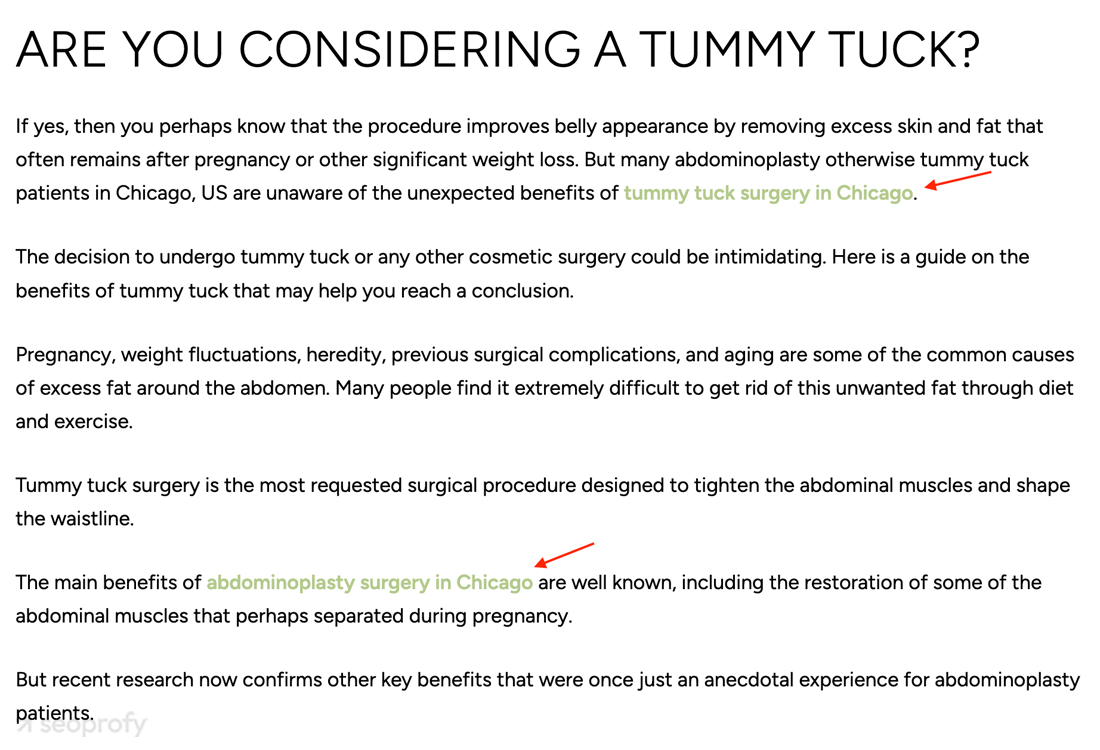
In practice, this helps Google associate each procedure with the correct city pages and helps visitors reach the right clinic without extra steps.
2. Technical SEO for Plastic Surgeon Websites
Plastic surgery sites use far more visual content than most medical sites, and that can influence how fast pages run and how the site feels while visitors browse. For that reason, technical SEO sits among the first areas to address in a plastic surgeon SEO strategy, and the sections that follow show you which areas you need to take care of, starting with site speed.
Site Speed and Core Web Vitals (Especially Image-heavy Pages)
Core Web Vitals are a set of metrics Google uses to evaluate on-page experience. They are considered a ranking factor (albeit small) and help assess how usable a page feels for your visitors.
Site speed is one of those metrics. Others include how responsive the page feels when someone tries to interact with it, and whether the layout stays stable as the page loads. All three connect back to how easy it is to use the site.
Data shows that for 88.5% of people, slow loading time is one of the main reasons they would leave a website. So not only does site speed influence your rankings, but it also directly affects how long people stay on your site and what percentage eventually converts.
To measure your CWV, you can use PageSpeed Insights. It’s a free tool that shows you diagnostics on both web and mobile, and gives you specific suggestions that point out what can be improved to help pages load faster.
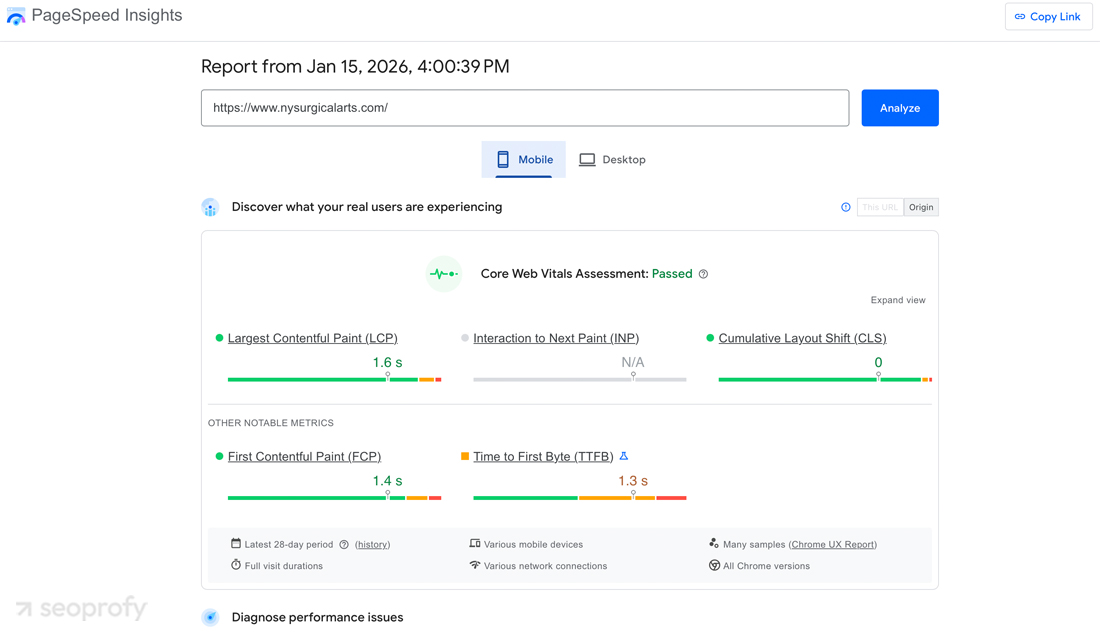
As a rule of thumb, here are a few best practices you can follow to keep your website fast:
- Compress images into formats like WebP and resize them before upload
- Lazy-load images so they open only as visitors scroll
- Remove unused code and plugins that slow pages down
- Use a content delivery network to serve files closer to visitors
Mobile UX for Conversion
Mobile devices account for 62% of overall web visits, and a large share of consultation requests for plastic surgeons are made on the phone. Because of that, small UX choices on mobile often have a direct effect on how many people reach out to your practice at the end of the day.
One of such mobile-first design choices is a sticky call button. This is the button that stays visible on the screen as a visitor scrolls through the page.
Why is it so effective? Mainly because it stays in front of customers as they research your site and gives them a little nudge to reach out.
Of course, there are many other design choices that plastic surgery clinics can benefit from. Here are a few of them you can try:
- Short consultation forms: Only ask for the basics, like name, email, phone, and a dropdown for procedure interest. No one has time to fill out long forms.
- Readable fonts and spacing: Text should be large enough to read without zooming in, and buttons need enough space around them so people can tap easily.
- Simple navigation: Mobile menus should be easy to scan. Keep your main procedure visible and create clear paths to “Book a Consultation” or “Contact Us.”
Crawlability, Indexation & Duplicate Content Control
An important part of search engine optimization is making it easy for Google to reach your pages, choose the right ones to index, and ignore extra versions that dilute rankings. On plastic surgery sites, this shows up more as the website expands and more pages get added over time.
Let’s start with crawlability. This is how Google moves through your site and discovers its contents. When your key pages sit close to your main navigation, search engine crawlers usually find them faster, and visitors do too. To keep your website free of crawlability issues, try to:
- Keep a clean XML sitemap that includes the pages you want to rank
- Use internal linking to strengthen relationships between your core services and city-specific pages
- Make sure robots.txt is set up properly, and any noindex tags match your intent
Next comes indexing. This is when Google crawls a page and decides whether it belongs in its index. Simply put, indexation determines which web pages can show up in the SERPs.
Sometimes a page gets crawled but still does not get indexed, and more often than not, the culprit is duplicate content. That’s when your site has multiple similar pages aimed at the same search intent, so Google hesitates on which version to index and rank. Luckily, there’s a way to deal with it. In terms of plastic surgery SEO, you can:
- Use canonical tags for near-duplicate pages and parameter-based URLs
- Stick to one site version (HTTPS and a single preferred domain format)
- Write pages with unique local details that make each one distinct
To check crawlability and indexation, you can use Google Search Console. This is one of the tools we’re using for our SEO audit services. It gives you a direct glance into what Google can access and what gets skipped, so you can see what needs to be fixed.
Site Architecture and URL Structure
After crawlability and indexing, the next logical step is site architecture and URL structure. Google uses these to move from one page to the next, and it’s also what decides how quickly a visitor can find the right procedure.
In SEO for plastic surgery, the goal is to group related topics so Google can see topical depth, and so patients can browse in a way that matches how they think. Most practices start broad, then narrow down. A site structure that works well looks like this:
Procedure hub → individual procedure pages → supporting pages
That means you start with a category page that introduces a group of treatments, then you nest each procedure under it, and finally, you add supporting pages that answer the next-step questions people search right after, like recovery timelines, cost ranges, and common FAQs.
Structured Data (Schema) for Medical Local Businesses
Structured data, also known in SEO as schema markup, is a snippet of code that helps search engines understand what your pages are about. It adds context around your clinic, your doctors, as well as the content on each page, which makes it easier for search systems to interpret what they’re looking at. A few schema types that are most common on plastic surgery websites are:
- LocalBusiness or MedicalBusiness that defines details like address, contact details, and opening hours.
- Physician that connects individual surgeons with the practice and their services.
- BreadcrumbList that shows the site structure and helps search engines understand the page hierarchy.
- FAQPage for common consultation or pricing questions that already appear on the page.
- VideoObject and ImageObject are mostly used for procedure videos and before-and-after visuals, so media content is easier to interpret.
Another benefit of structured data is that it helps your plastic surgery content show up more often in AI answers, be it in Google AI Overviews or inside AI tools.
Technical Trust Signals (Security + Compliance Basics)
Patients share sensitive info right from the first consult form on plastic surgery sites. Your technical setup has to back that up with pro-level security. Here’s how to do that:
- Enable HTTPS site-wide to encrypt every form submission and page load for complete security.
- Use secure contact forms and minimize third-party scripts touching form data.
- Link the privacy policy under every form with clear data retention and GDPR details in plain language.
- Disclose analytics or pixels upfront with one-click opt-out options to build loyalty.
These trust signals reassure visitors that your site is secure, and Google views them as proof of a reliable practice and considers them in rankings. And now that the technical setup is covered, let’s look at on-page tactics to improve your visibility in search results.
3. On-Page SEO Strategies For Plastic Surgeries
On-page SEO is when you optimize all the elements on your site so that they align with what plastic surgery patients search for, give clear answers, show proof, and guide them to book a consultation. Let’s start with finding the right keywords to target first.
Keyword Research (Patient Language + Intent Mapping)
To do on-site SEO effectively, you first need to find the exact terms and phrases your prospective patients type into Google. People usually move through different stages before booking, and each one comes with its own type of query. These are:
- Informational: People want recovery details or risks (“rhinoplasty recovery timeline” and “tummy tuck risks”).
- Commercial: They compare surgeons or options (“best breast augmentation surgeons” or “facelift vs thread lift”).
- Transactional: They’re ready to book (“rhinoplasty consultation” or “schedule facelift near me”).
- Local: Always location-based (“plastic surgeon Chicago” or “tummy tuck Seattle”).
You generally want to target all these types of keywords in your plastic surgeon SEO efforts and content strategy, and pay special attention to the ones that are further down the funnel.
To find these keywords, you have a few options. If your budget allows it, tools like Ahrefs usually give you the most comprehensive data and help you to filter terms by search volume, keyword difficulty, intent, and many other metrics.
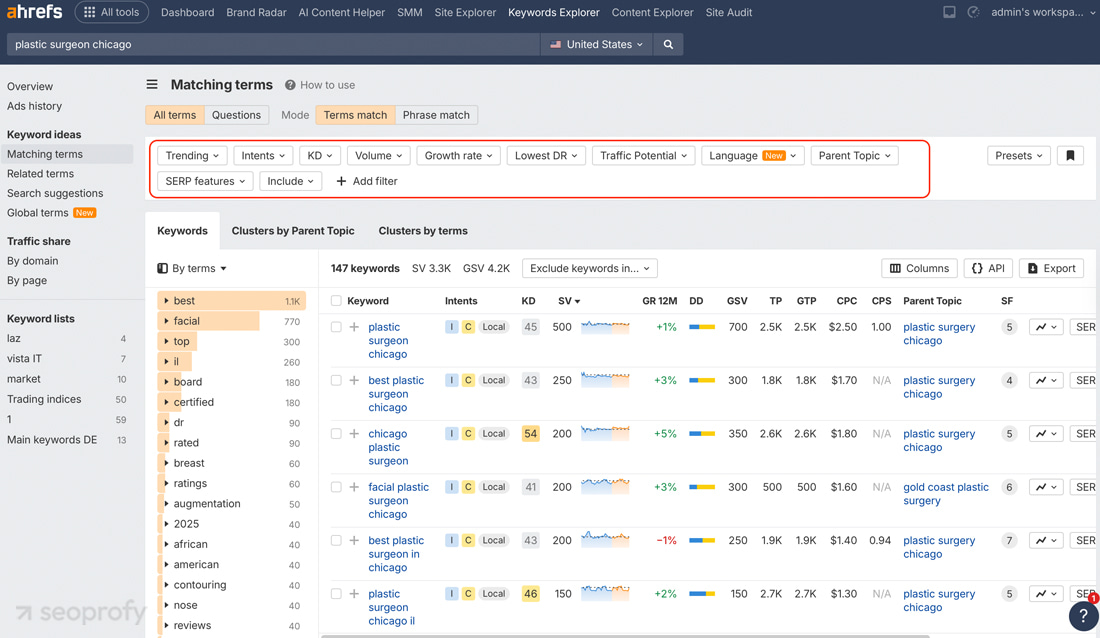
As for free tools, you can use Google Keyword Planner and AnswerThePublic. The latter is great for finding conversational, long-tail keywords that you can use in headings and FAQs.
Content Creation and Optimization
You already know what people search for and why they search for it. Now the job is to reflect that intent on your website.
In plastic surgery SEO strategies, this work mostly happens on procedure and service pages. These are the pages patients usually land on when they’re comparing options and deciding whether to book a consultation.
As for best practices, your website pages need to be written around the main procedure term, and special attention needs to go into the FAQ section. This is where most people go to find answers on how they can prepare for the procedure and how long the recovery will take. Here’s a good example of how you could structure it:
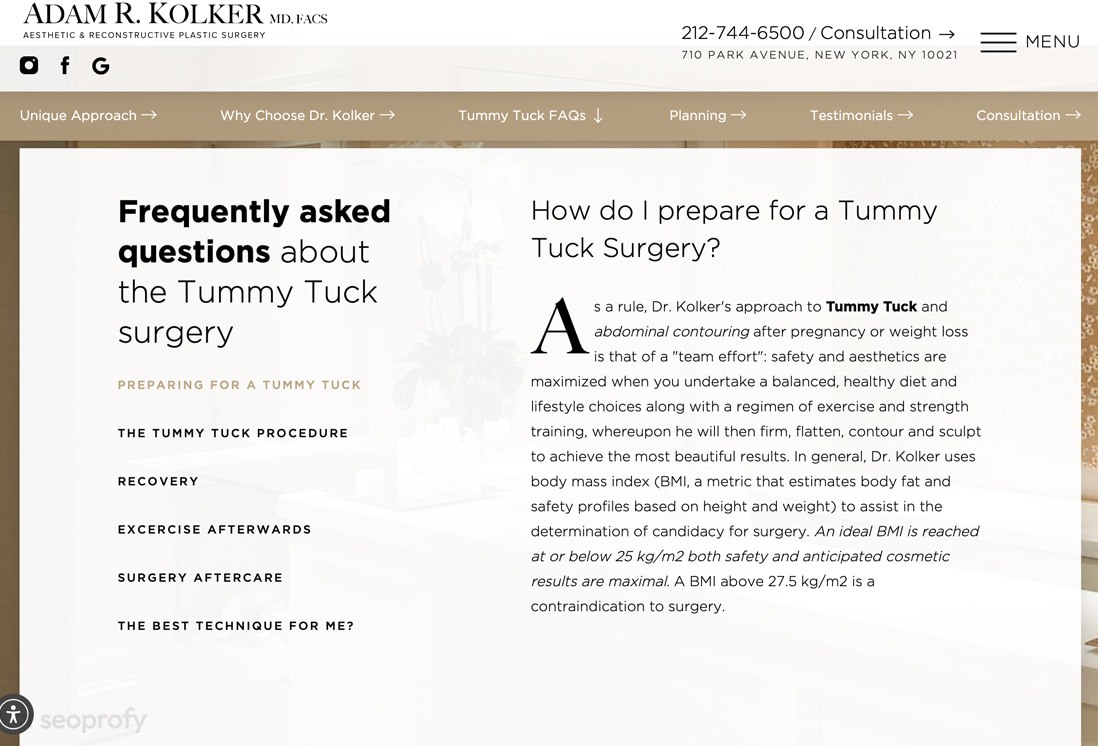
In short, your content and optimization work should do two things at once. It should help your pages rank for the main keywords and make it clear to Google what the page is about. At the same time, it should answer all the common questions your potential patients might have to remove uncertainty and nudge them towards the next step.
Meta Tags (Titles + Descriptions that Improve CTR)
Meta titles are what people see before they click on your site. In practice, they often decide whether someone clicks your page or keeps scrolling.
For procedure and location pages, the job is to say exactly what the page offers, without trying to oversell it. Start with the procedure and the city, so it’s immediately clear who the page is for. A good example can look like this:
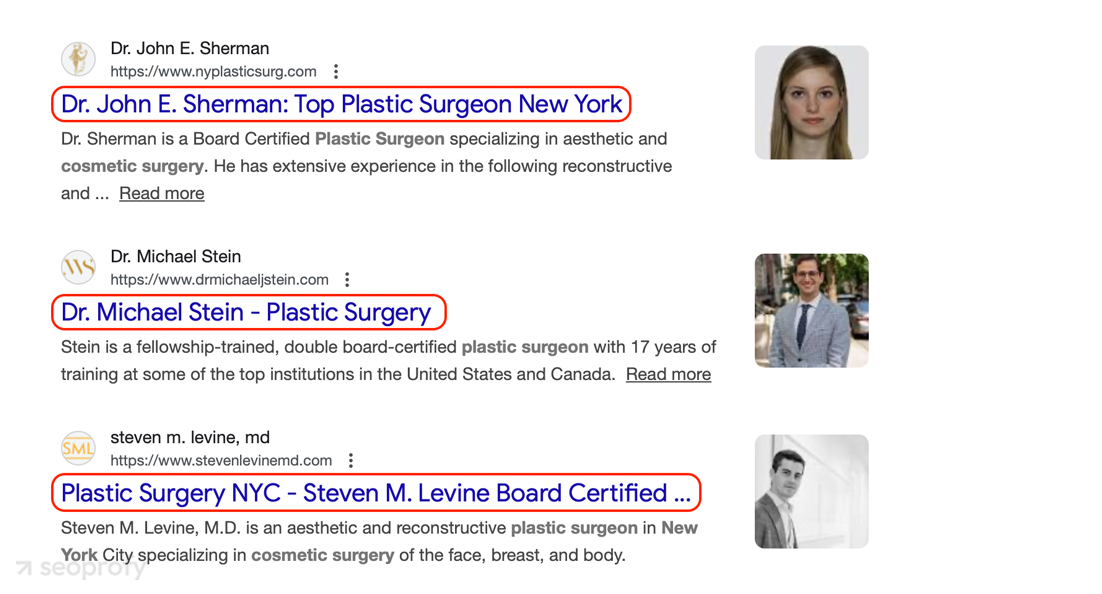
As for meta descriptions, they help you expand on the title and give people more reasons to click. You can mention what sets your practice apart, such as free consultations or years of experience.
Trust details work well here, but only when they’re real. If you’re board-certified, it’s fine to mention it. If not, leave it out.
Heading Structure and Answer Formatting
Your heading structure helps organize the page, but it does more than that. It tells Google and AI models what each section is answering, and helps visitors find what they’re looking for faster. A few recommendations for organizing your pages:
- Write optimized headings in conversational English
- Open each section with a short, direct answer
- Use bullet lists and tables where possible for easier reading
All of this helps your pages work better for both sides. Patients can find the information they care about, and Google and AI systems can process the page more easily and use it in their answers.
Conversion Elements that Support Rankings (and Revenue)
We touched a bit on how design elements like sticky buttons can help drive more consultation requests. But there are other on-page elements that do double duty: they build trust with patients and send the right signals to Google at the same time. Here are some of them:
- Board credentials: Display certifications from organizations like the American Board of Plastic Surgery on your homepage and procedure pages. Visitors often look for these, and Google treats them as credibility markers.
- Years of experience: Mention how long you’ve been practicing or how many procedures you’ve completed. Something like “Over 15 years of experience” or “500+ rhinoplasty procedures.”
- Real reviews from past patients: Add testimonials to procedure pages with the patient’s first name and procedure type. These provide social proof and give Google more relevant context.
Of course, there are many more CRO tactics you can use as a plastic surgeon, but these give you the most leverage and highest return in both conversions and rankings.
Turn your website into a steady source of consultation-ready traffic. Our team can help you:
- Rank for high-value procedure searches in your area
- Get more leads and consultation requests
- Build trust in the eyes of patients and Google

4. Off-Page SEO for Plastic Surgeons
So far, we’ve talked about local and technical SEO, as well as on-page tactics that can help your site perform and rank better. Our next section focuses fully on plastic surgery link building.
We’ll share a set of methods on how your practice can strengthen credibility online and improve rankings through high-quality backlinks and mentions from trusted sources. Let’s start with the first tactic.
Digital PR and Local Media Mentions
One of the most common ways for plastic surgeons to earn backlinks is through local media and community coverage. Local outlets regularly look for expert input on health and cosmetic topics, and plastic surgeons are a natural fit for it. Examples of how you could do it in your off-page SEO efforts include:
- Sharing expert tips with local publications on plastic and cosmetic surgery topics
- Participating in local news segments related to cosmetic trends or patient safety
- Being involved in relevant community events or charity initiatives
These mentions often include a link back to your site or at least a branded reference, both of which help strengthen your online authority.
Ethical Link Building through Professional Associations
Another source of backlinks comes from places where your practice already has a professional presence. Such links often have higher authority because they come from relevant medical and local organizations. Common examples include:
- Profile pages on medical associations
- Speaker pages from conferences and panels
- Hospital affiliations or academic listings
These links signal that your practice is established and connected within the medical community, which supports how search engines evaluate authority.
Social and Video Distribution that Supports SEO
Social media and video platforms are not direct ranking factors, but they play an important role in how your content gets discovered, shared, and referenced online. For plastic surgery practices, visual content in particular can extend the reach of your expertise and increase the chances of earning natural backlinks and brand mentions.
Examples of how to use this effectively include:
- Share educational videos on platforms like YouTube, Instagram, or TikTok that explain procedures, recovery timelines, or common patient questions.
- Repurpose blog content into short-form posts and clips that drive traffic back to your main website pages.
- Publish expert commentary or behind-the-scenes content that journalists and bloggers can reference in their own articles.
Over time, this type of distribution strengthens brand recognition, increases the likelihood of external mentions and links, and supports how search engines evaluate authority and relevance around your practice.
Reputation Signals Beyond Google Reviews
Reviews are important, but they are only one part of your broader online footprint. Search engines also look at how consistently your practice appears across trusted platforms. This includes:
- Accurate and consistent practice information across major healthcare directories
- Active and well-maintained profiles on medical listing sites
- Professional responses to mentions or discussions where engagement is appropriate
When your practice information is visible across all these sources, it reinforces legitimacy and helps support higher rankings over time.
What to Measure in a Plastic Surgeon SEO Campaign?
SEO only works if you know which metrics are improving and why. The goal here is to understand which efforts deliver the results you’re aiming for and which ones need to be changed. As for the metrics to monitor, here’s a KPI checklist we use at our plastic surgeon SEO company:
| Metric | Timeframe | What it shows | Attribution & tracking notes |
| Search engine rankings (procedure + city) | Weekly | Visibility for high-intent searches | Track via rank tracking tools by location |
| Local pack visibility | Weekly | Map presence for priority locations | Monitor through local rank tools and manual checks |
| Google Business Profile actions | Weekly | Calls, clicks, and direction requests | Use GBP Insights with call tracking enabled |
| Organic traffic to procedure pages | Monthly | Interest in specific treatments | Track in GA by landing page and channel |
| Organic traffic to location pages | Monthly | Local demand by the city | Segment by page path in GA |
| Organic consultation requests | Monthly | Leads driven by SEO | Combine form tracking and call tracking |
| Branded vs non-branded traffic | Monthly | Brand awareness vs demand capture | Separate queries in GSC or GA |
| Form submissions from organic | Monthly | Consultation intent | Track via form events tied to organic sessions |
| Calls from organic search | Monthly | Phone leads from SEO | Use dynamic call tracking numbers |
North-Star Metrics for Plastic Surgery Practices
You can track a lot of numbers, but not all of them deserve the same attention. For clinics, our SEO company usually keeps an eye on three metrics first:
- Organic consultation requests
- Visibility for procedure searches in your primary cities
- Local pack presence for your main location
If those three improve, it’s safe to say your data-driven SEO for plastic surgeons is moving in the right direction. Similarly, you can note which exact tactics led to these results and double down on them in future campaigns.
The Bottom Line
If you made it this far, you clearly care about SEO and want to make the most out of it for growing your practice. That’s a good thing, because search is changing, and each plastic surgery practice is feeling it too.
AI-overviews now appear for 40.2% of local business queries, and as large language models become more common, people are starting to look for cosmetic surgeons directly inside these tools. That changes how visibility works, especially for practices that rely on local demand.
The clinics performing best right now are still doing the fundamentals well, but they’re also paying attention to how their content and authority show up in AI-driven results.
If you want help combining both approaches, book a free call with our team. Our plastic surgery SEO services can help you maximize the benefits of SEO and GEO, so you can rank higher for procedure searches and grow consultation requests from your local area.

Khrystyna Dzhumaryk is a content writer at SeoProfy with four years of experience in SEO and content strategy. At the company’s main blog, she writes in-depth articles and guides to help businesses improve their online visibility through proven tactics. Her work brings together hands-on SEO experience with ongoing research into algorithm updates, search trends, and the growing impact of AI on content and optimization.