

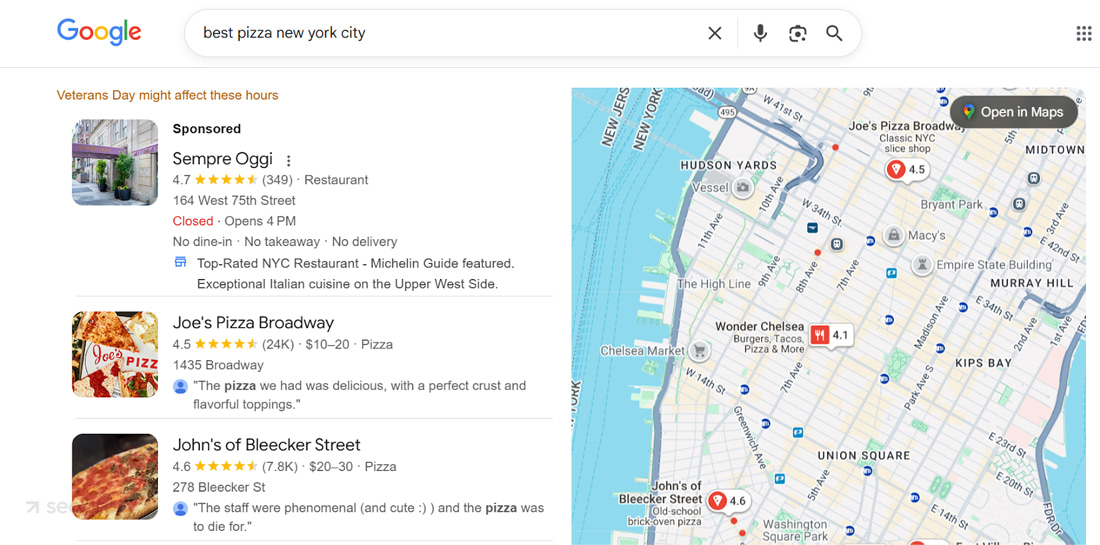
The Google 3-Pack is a SERP block featuring the top three relevant businesses for local search intent. Displayed above organic results with a map, it shows key details: name, address, working hours, and rating. Getting to this local pack is essential for capturing immediate website visitors, calls, and foot traffic.


The Google 3-Pack is the shortlist of three local businesses displayed with a map, ratings, and key details whenever a search has local intent. It often beats traditional organic results because users see it instantly and can act right away — call, visit, or check reviews. For many local businesses, this placement becomes a major driver of traffic and leads.
To dominate Google Maps 3 Pack, you must show Google that your business is relevant, trustworthy, and clearly connected to the searcher’s location. That comes from an optimized Google Business Profile, steady review activity, consistent NAP data, and strong local prominence through citations and backlinks.
- Optimize your Google Business Profile fully.
- Target accurate service areas.
- Earn and respond to reviews regularly.
- Build prominence with citations and local backlinks.
- Keep NAP information consistent everywhere.
Introduction to Google Local Pack Algorithm
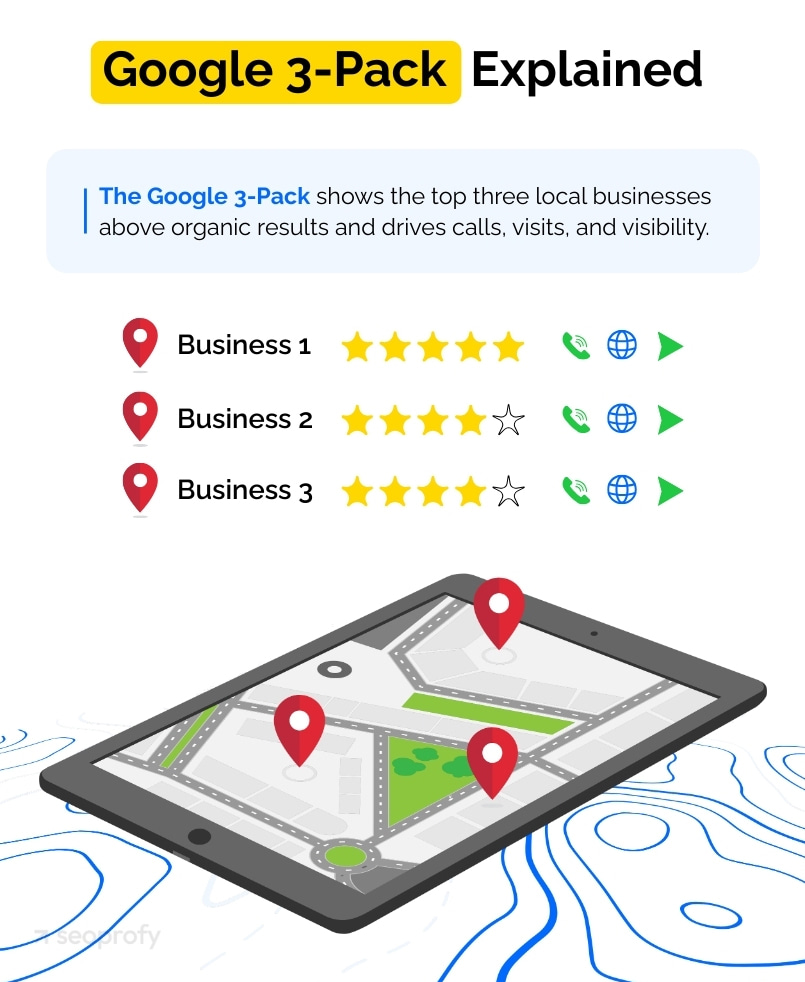
The local pack is commonly triggered with multiple local query types:
- [SERVICE] near me
- Best [SERVICE] + [CITY]
- [SERVICE] + [CITY]
The Google 3-Pack provides the essential information for a user to make an instant, informed choice: a place to go, a shop to visit, or a service to order. The information displayed in the local pack is taken from various sources. The prime one is your Google Business Profile. Also, this block features user photos and reviews.
The key thing to understand about this SERP feature is that it is designed for maximum user convenience. This principle should guide your pack presence optimization. Initially, the local pack was presented with seven company options, but in 2015, it was optimized and reduced to three positions only, simplifying the choice of a target user.
The local businesses are also ranked within the pack. To get to the first position, you need to understand what Google 3-Pack ranking factors are applied, how to optimize your GBP, and what other actions to take for success.
How to Get in the Google 3-Pack: Key Local Ranking Factors
Google keeps search algorithm details confidential. However, there are three proven ranking factors that local business owners should focus on to dominate the Google Maps 3-Pack. The system estimates relevance, distance, and prominence. Let us review each factor and understand how to optimize your Google Business Profile.
Relevance
Relevance indicates how closely your company aligns with a user’s intent (i.e., what the user is looking for). To better understand it, Google uses information you provide in your profile and from other sources (like user reviews). To improve relevance, ensure consistency and accuracy of your data across the web (your site, local business listings, social media, etc.)
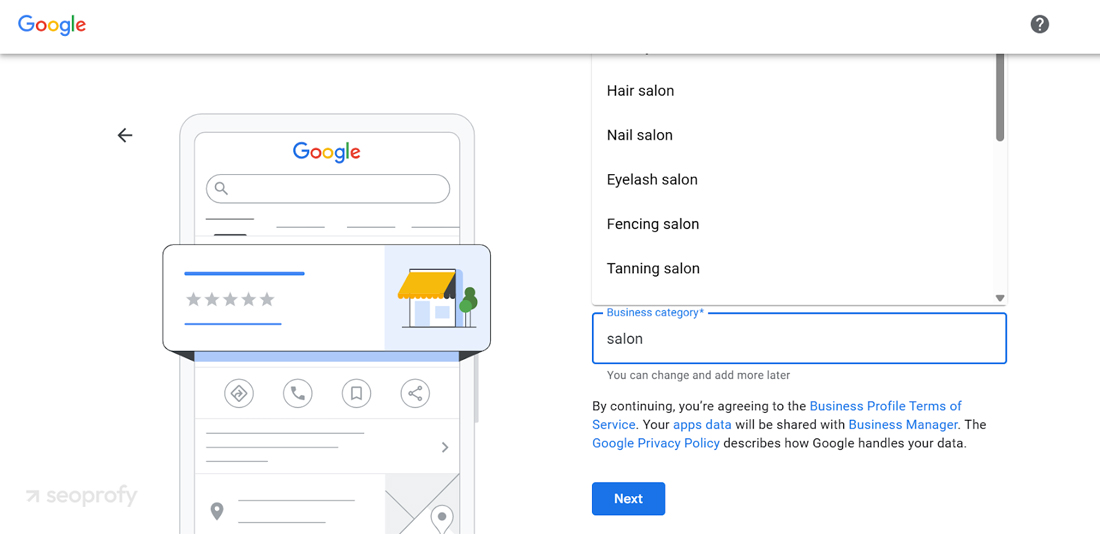
Choose a specific category that best matches what you do. For example, instead of “Salon”, choose “Hair Salon”. The categories primarily inform users about your main offer. They help connect your business with customers searching for your products or services. This can happen, that the list does not have a necessary specific category. In this case, you choose a general one, but make a very precise description.
Local keyword research will inform the correct words to use on the website, in the GBP profile for business and services descriptions.
Distance/Proximity
When choosing local businesses to display in the Google 3-Pack, the search engine prioritizes the proximity of a business to users. If they do not share their location, the Google Local Pack algorithm uses the data it has. You cannot directly affect this factor; thus, your task is to ensure the correct name, address, and phone number across all platforms. If you do not serve customers at your location, you also need to set service areas: locations where you can provide your services or deliver products:
- Your GBP can have up to 20 service areas.
- The overall boundaries should not exceed a 2-hour driving time from your business location.
Prominence
Prominence indicates how well-known your business is in the area. The higher the prominence, the higher the probability that the business will appear in the Google 3-Pack. Though all the signals for prominence calculation are unknown, Google highlights two of them:
- Number of websites linking to your business.
- Number of user reviews.
More links, reviews, and high ratings improve a business’s Google 3-Pack ranking. Reviews and ratings are powerful indicators of trust for users.
Optimize Your Google Business Profile
GBP is a free tool that lets you manage how your business is listed and ranked in local search results. The verified Google Business Profile enables you to manage and provide accurate information about your company, services, and products, interact with customers by posting photos or responding to their reviews, and attract new customers.
However, simply adding a business to Google will not be effective. The local search results are ranked similarly to the traditional search. Hundreds of companies compete for user attention. Let us review the best optimization practices to ensure your business appears in the Google 3-Pack.
Claim and Complete Your GBP
First, check if your business is listed in Google. To do so, you need to open Google or Google Maps on your computer and enter the business name in the search bar. If the business appears in search results, you will find a button labeled “Claim this business.” Then, select a verification option and follow the instructions.
If the business is not listed in the search results, then you need to add it here and follow the instructions. Verification is necessary to gain ownership and manage business information, add photos, and respond to user reviews.

GBP verification can be completed through various methods:
- Video recording
- Phone or text message
- Live video call
Google needs up to 5 days to review the verification. A confirmation email will be sent to you. After that, you will be able to manage the information in your profile and communicate with users.
Fill out the data accurately, as it will guide potential customers:
- Business address: Enter an exact and complete address, including building, suite, floor number, and any other relevant unit information.
- Working hours: Set your main business hours, breaks, and special hours. Mind that after the changes, users will see a post about recent hours updates on your business profile. It is published automatically.
- Service areas: Set locations that your business serves.
- Services: Select all relevant services from the drop-down menu. If a certain service is missing, then you can add it manually. Some custom services may not be permitted and will be automatically rejected by the system.
- Local business links: These links enable users to take immediate actions, such as placing orders, booking appointments, and making reservations.
- Profile description: This is one of the top focus sections. Add a relevant, simple, and clear description of your business so the algorithms and users can understand what you offer. Conduct keyword research to add more relevant words and terms people commonly use to find companies and services. GBP profile offers an AI feature to create or improve the description.
- Business category and attributes: Select the category that is most relevant to your company. Business-specific attributes help you stand out and provide more details to potential customers (for example, free Wi-Fi, pet-friendly zones, outdoor seating, etc.).
If your business operates in multiple areas, utilize multi-location SEO best practices to ensure effective optimization that enhances visibility, drives conversions, and attracts qualified foot traffic to every brick-and-mortar site.
When editing the Google Business Profile, please make sure that the data is consistent across the web: your website, GBP, social networks, local directories, etc.
We know why your business doesn’t show up in local search! SeoProfy uncovers the ranking gaps and strengthens the signals Google actually values.
- SEO Audit – fix technical and on-page gaps
- Keyword Mapping – match real local intent
- GBP Optimization – boost relevance and visibility
Add Photos, Videos, and Posts Regularly
GBP works like your additional media channel where you can share photos and videos, drop comments and posts about your business, customers, achievements, or important updates. Live photos and videos make your business more attractive to potential visitors and provide more context about the location, premises, environment, interior, and more. According to Google, businesses that add photos to their GBPs tend to get 42$ more directions requests on Google Maps and 35% more clicks to their websites. They also contribute to your GBP authority and help your business stand out on Google search results.
Google suggests the following types of photos for your profile:
- Exterior and interior shots
- Product, food, and drink photos
- Work process and team
- Rooms and common areas.
The algorithm rewards companies for maintaining up-to-date and active profiles. New photos and videos help build customer trust, improve Google 3-Pack rankings, and attract new customers.
Solicit and Respond to Reviews
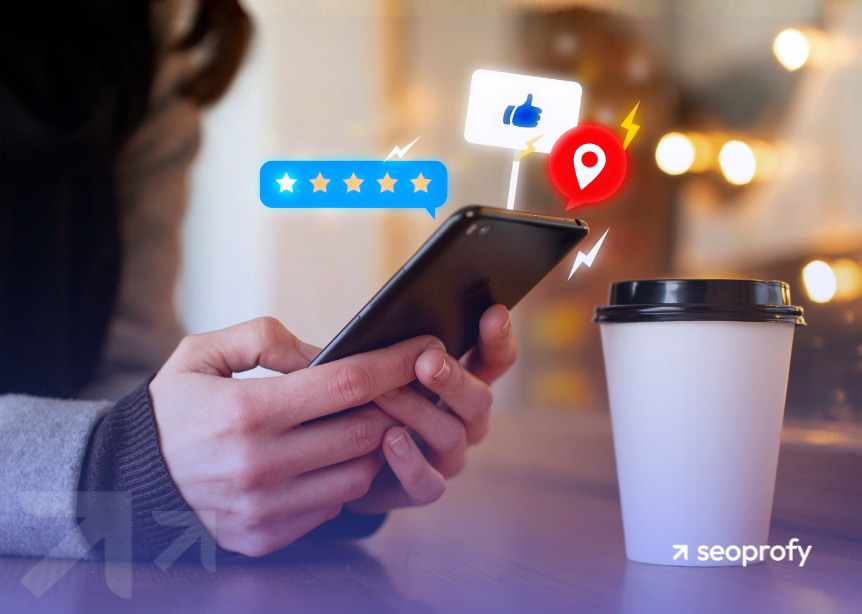
Local SEO statistics indicate that 75% of users always or often look for reviews before visiting a business, and 89% will choose a business that responds to all reviews. 63% of users say they would lose trust in a business if they mostly see negative reviews. At the same time, 38% find reviews “very important” in their decision-making process. Users place higher trust in recent reviews compared to older ones.

Reviews are essential for users and Google. The search engine uses them as a ranking signal, as they inform the Google Local Pack algorithm about the trustworthiness of your business, its popularity, and relevance. Google counts the number of reviews, their quality, and the business engagement to rank it in local search and on Google Maps.
Online reputation management is critical for a higher ranking. Motivating your customers to leave reviews will boost visibility, CTR, and conversion. Your timely replies will signal to Google that you value customer feedback and care about their experience with your company, products, and services.
Optimize Website for Local Relevance
When your GBP is ready, it’s time to focus on website optimization. The local SEO services cover:
- Content optimization: The content includes local keywords, the pages are optimized for local search intent, and NAP (Business Name, Address, Phone) data is added to the main landing pages of the website.
- Mobile optimization: The website loads fast on mobile devices, its UI is optimized for mobile display size, and all essential data and interaction elements are instantly available on the first screen.
- Metadata: The title and description contain local-specific keywords, highlighting their value. They are relevant to the page content and concise.
- Internal linking: The website does not have broken internal links. They are properly and logically added with relevant anchor texts to provide context and to improve user navigation.
Use sound judgment in all your decisions to avoid overoptimization.
Citations and NAP Consistency for Higher Google 3-Pack Ranking
Organic mentions in authoritative media and local business listings signal trust to Google and potential customers. It is important that a business is consistently presented across the web. Here is how to make it.
What Are Local Citations?
Local citations are mentions of essential business data on relevant media, directories, or applications. These mentions work for both: they help customers find a business and provide Google with reference data to verify the company’s legitimacy, which is crucial for local SEO optimization. Some media outlets or local business listings suggest reviews, providing an additional entry point for users to share their feedback.
Apart from mentioning your brand, providing its name, address, phone number, and additional information, local citations improve your backlink profile. Though most directory citations use the nofollow attribute, Google may still consider these links as hints for estimating a website’s authority and ranking position.
Maintain Consistent NAP
NAP stands for Name, Address, and Phone Number. It is essential to ensure that all citation platforms provide consistent information about your company and its offerings. This improves the business’s local rankings and enhances the user experience by providing accurate data to contact your business. The best local SEO strategies advise against focusing solely on Google and Google Maps. Utilize all available citation opportunities, such as Bing Places, Yahoo Local, Apple Maps, etc.
Use Data Aggregators
To ensure consistency, you can use data aggregation services that distribute provided business data to essential online directories, applications, and search engines. For businesses within the USA, there are options such as Data Axle, Foursquare, TransUnion Digital Business Profile, and BrightLocal, among others. Such an approach will save you time and effort, and boost visibility, as the citation can take a more prominent position on the first search results page.
Periodic Audits and Cleanup
For the sake of consistency, make sure to check all citations regularly and verify the accuracy of the business name, address, and phone number. Once the data has changed, you need to request editing so that potential customers receive the correct contact information and addresses. To effectively track all citations, you can use tools such as Google Alerts, Mention, or SEMrush.
Other Local Signals and Tactics to Dominate Google Maps 3-Pack
Apart from GBP optimization and local citations, there are other signals checked by the Google local pack algorithm to rank a business. Among them are local backlinks, optimized content, and social media.
Local Backlinks & Partnerships
Backlinks from authoritative and relevant local websites and news outlets send strong signals to Google that your business is legitimate and trusted in the area. Links from local media carry more weight for local SEO than those from other sources, while partnerships boost search visibility and user trust. Collaborations with local businesses drive additional mentions and inbound links.
Content with Local Focus
Content is a major ranking factor in local search engine optimization. Valuable, well-optimized local content will help your website rank better and attract more organic traffic. When we talk about local focus, we mean the following:
- Technical optimization of your pages’ content and meta tags by adding local-specific keywords, such as [service in city]. This step helps Google better understand your business location and the services you offer.
- User intent optimization by creating content that actually helps local users solve problems — like guides, tips, or resources specific to their area. It builds trust, engagement, and authority.
For example, rather than just writing “Plumbing Services in Chicago,” consider creating a blog article like: “How to Prevent Frozen Pipes This Winter in Chicago: Tips from Local Experts.” This approach not only uses local keywords but also meets user intent with valuable, area-specific advice.
Social Media and Engagement
Social media accounts may not directly impact local rankings, but they are an important signal. Business activity on social media builds community trust and increases brand search volume, supporting local visibility indirectly. Regular company updates, timely communication with followers, and positive community feedback (likes, comments, reposts) boost user awareness.
Google Search and Google Maps are the most frequently used tools for local queries. Earning a spot in the Google local pack is no longer optional. It is a crucial step for any business seeking local search visibility and trust.
A fully optimized Google Business Profile, consistent local citations, optimized content, authoritative backlinks, and social media activity are part of local SEO for small businesses, which strengthen the signals, improve rankings, and attract qualified local customers. A structured approach to GBP ensures your business dominates the Google Maps 3-Pack, making it visible in local search and positioning it as a trusted go-to choice in your area.

Bohdan has been an SEO analyst at SeoProfy for more than two years. He began his career in digital marketing in 2019 and has since gained experience helping scale some of the world’s leading brands in industries such as gambling and SaaS. Bohdan specializes in developing effective strategies tailored to specific regions.