


Enterprise SEO pricing commonly starts in the $7,000 to $21,000+ per month range and often rises once the business setup and targets get more demanding. The pricing is tied to the reality of enterprise work: international SEO, complex technical problem-solving, and content output that operates at a scale regular search engine optimization simply doesn’t cover.


The SeoProfy team reviewed the market and pricing models used by companies offering enterprise-level SEO services and pulled together a clear breakdown of what’s really behind those numbers. In this article, we explain which services are typically included at this level and what factors push costs up or down. If you’re planning a digital marketing budget for an enterprise business, this guide gives you the clarity needed.
- The strongest ROI comes from working with an experienced SEO agency.
- Enterprise SEO budgets typically range from $7K to $21K+ per month.
- Most programs require 80 to 240+ hours per month at an average rate of ~$90.7/hour.
- Key cost drivers: technical SEO, keyword research at scale, content optimization/production, link building, and automation.
What Is Enterprise SEO and Why Does It Cost More?
Enterprise SEO is the practice of optimizing large, complex websites at scale, where search performance depends on architecture and processes rather than individual pages. Naturally, this level of SEO often costs far more than promoting a simple landing page for a local service provider. However, once you break it down, the pricing becomes easy to justify:
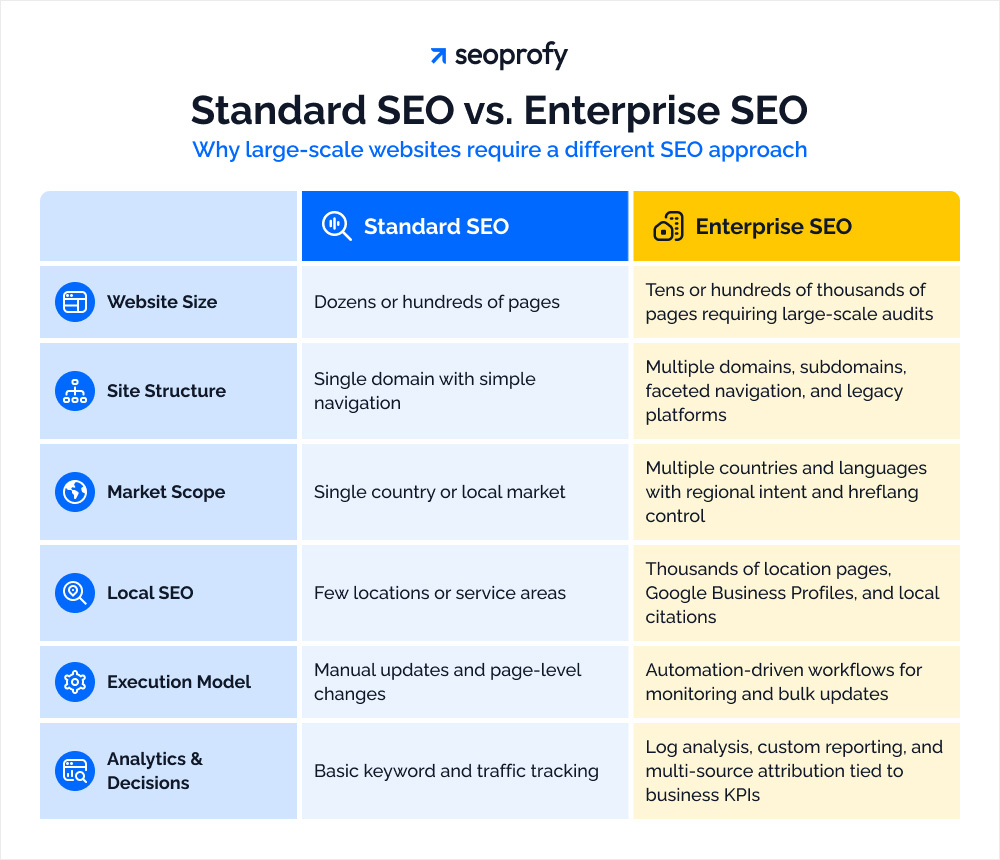
- Large websites & audits: Enterprise-level sites have tens or hundreds of thousands of pages that need massive audits to ensure technical changes don’t hurt their search rankings.
- Complex structures: Multiple domains, subdomains, faceted navigation, and legacy platforms require architectural SEO decisions that stay development-friendly over time.
- Global markets: Search visibility spans multiple countries and languages, with precise control over hreflang, regional intent, and localized SERP behavior.
- Local SEO at scale: Managing thousands of location pages, Google Business Profiles, local citations, and regional landing pages across cities or countries adds another layer of operational and technical complexity.
- Automation: Ongoing monitoring and bulk updates rely on automated workflows, since manual processes break down at this scale.
- Advanced analytics: Decisions are driven by log analysis, custom reporting, and multi-source attribution tied directly to business performance.
How Much Does Enterprise SEO Cost?
In short, enterprise SEO pricing typically falls in the $7K to $21K+ range, depending on multiple factors that influence cost and scope, which we break down in the next section. And here’s a more detailed view:
According to recent data from Clutch, hourly pricing for enterprise SEO services is approximately $90. Most enterprise engagements require 20 to 60 hours per week on the agency side. So, how much does enterprise SEO cost?
- 80–120 hours/month → $7,200–$10,900 → One main market, limited development dependency.
- 120–180 hours/month → $10,900–$16,300 → Multiple site sections, continuous technical work, content creation at scale, regular coordination with development teams.
- 180–240+ hours/month → $16,300–$21,800+ → International footprint, complex architecture, frequent releases, heavy analytics, and automation-driven workflows.
What Factors Influence Enterprise SEO Pricing?
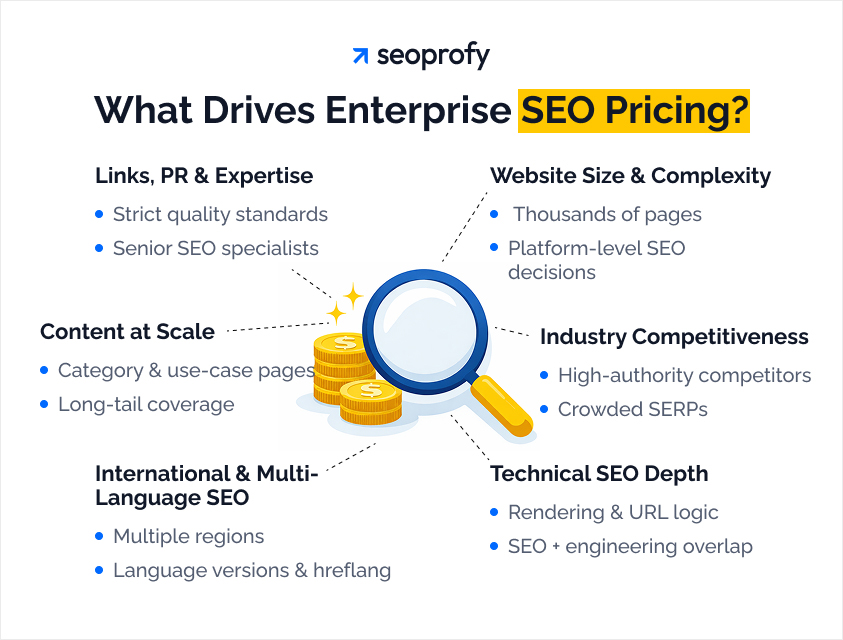
You may be surprised by how wide the pricing range is and wonder what actually drives that difference. Below are the key factors that determine enterprise-level SEO services pricing.
Size and Complexity of the Website
When a site is small, SEO usually means tuning on-page elements, building authority, and pushing specific URLs. At enterprise scale, this approach stops working because you’re dealing with thousands of pages at once, so the focus shifts to how decisions scale across the entire platform.
One technical change can impact large sections of the site, for better or worse, which means search optimization becomes tightly connected to product and engineering decisions. This is what calls for advanced technical SEO, drives the workload and, as a result, the cost.
Industry Competitiveness
Ranking an enterprise B2B software platform that targets a narrow set of branded or problem-aware queries is very different from competing in industries like fintech, online education, or large ecommerce marketplaces.
In finance, for example, you compete with banks, aggregators, and publishers that have years of authority and massive content depth. In ecommerce, brands often fight Amazon, Walmart, and category leaders for the same commercial terms. More pressure equals more SEO effort, which directly increases cost.
Technical SEO Depth Required
Technical SEO affects pricing when optimization work directly changes how the site generates, renders, and serves pages. On large ecommerce, SaaS, or media platforms, this includes JavaScript rendering, URL logic, filtering rules, internal linking at scale, and release-related changes.
Issues usually repeat across templates and systems, so one decision can affect thousands of pages at once. At this level, SEO work overlaps with engineering tasks, requires validation before rollout, and consumes more hours and money.
International and Multi-Language SEO Requirements
A single market allows one search intent model and one content strategy. Multiple regions introduce different intent patterns, search behavior, and SERP layouts. Language versions also create technical complexity around URL structure and page relationships. Every new market adds more international SEO work:
- Content planning
- Technical validation
- Ongoing maintenance
Take H&M as a clear real-world example, which follows all the hottest enterprise SEO trends. Their SEO efforts run separately for each region, starting with market-specific keyword targeting and extending all the way to site layout and full content localization. Look at the contrast between the Spain and the United Arab Emirates websites. Now scale that level of work across dozens of markets worldwide and see how it can influence enterprise SEO pricing.


Content Requirements at Scale
For small sites, a few strong pages can drive visible SEO results. At the enterprise level, content must support entire site sections, product lines, or categories. Large ecommerce brands need scalable category content, search-friendly filters, and supporting pages for long-tail demand.
SaaS platforms and marketplaces often require hundreds of use-case pages just to cover real user intent. Planning, producing, and maintaining content at this scale takes ongoing effort, which directly increases enterprise SEO cost.
Link Building & Digital PR Complexity
At enterprise scale, link building is limited by several factors, which make every placement slower and more expensive:
- Brand risk control: Link sources must meet strict quality standards to protect the reputation.
- Legal and compliance reviews: Outreach and PR activity often goes through legal approval, especially in regulated industries.
- Higher editorial thresholds: Top-tier publications require original data or strong news angles.
Experience, Team Size, and Agency Reputation
Enterprise SEO campaigns require specialists who have already dealt with large platforms and complex releases. For example, at SeoProfy, our team brings over 13 years of hands-on SEO experience, with deep enterprise expertise. We’ve built a balanced structure that combines senior leadership with strong execution specialists.
That level of expertise reduces mistakes, shortens decision cycles, and improves outcomes at scale. However, maintaining top talent, strong processes, and a growing reputation means SEO cannot be priced at entry-level rates.
What Pricing Models Do Enterprise SEO Agencies Use?
The best enterprise SEO companies use different billing frameworks. Organic search services are structured around hourly rates, project-based work, or monthly retainers. Each approach has its own logic, strengths, and trade-offs. Here’s an enterprise SEO pricing models comparison table:
|
Pricing model |
Pros |
Cons |
| Hourly-based | Transparent tracking, flexible scope, easy to scale up or down | Hard to predict the final monthly cost |
| Project-based | Clear deliverables and timelines, good for audits or migrations | The scope changes often trigger extra costs |
| Monthly retainer | Stable budgeting, long-term enterprise SEO strategy alignment | A fixed scope can hide workload gaps |
Seeing fixed prices on an agency’s website may look reassuring, but in reality, it’s hard to take those numbers at face value. Without analyzing your site’s technical state, competitive pressure, and goals, it’s almost impossible to predict the amount of work required and stick to a fixed price.
What’s Included in Enterprise SEO Services?
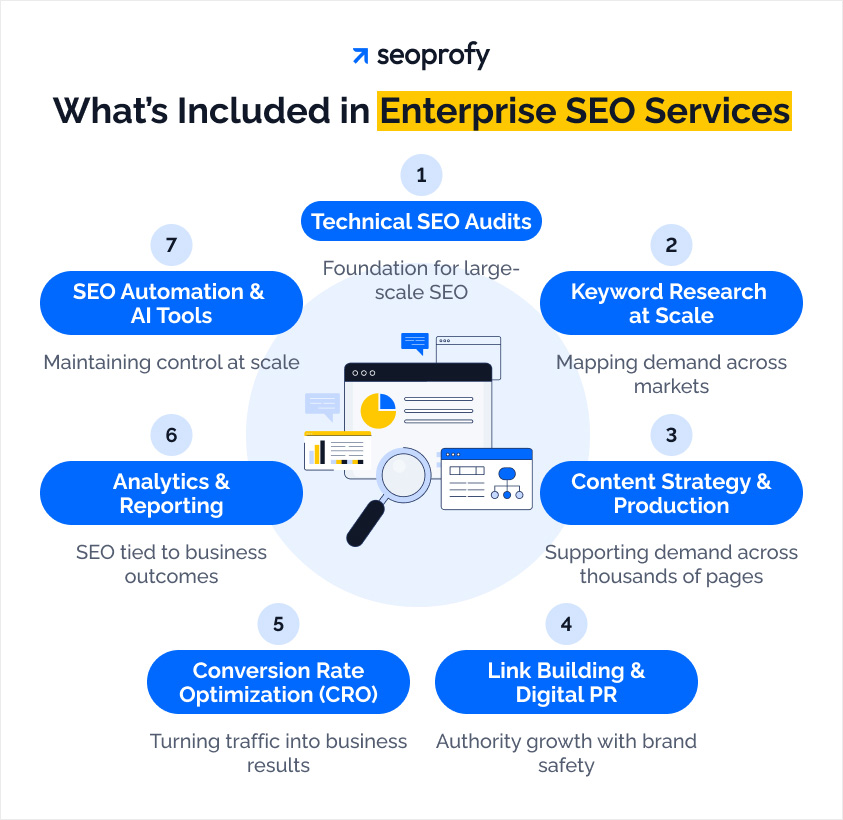
Now that we’ve covered how much enterprise SEO costs and why pricing is higher for large-scale projects, it’s time to look at what you’re actually paying for. Below, you’ll find the enterprise-level SEO services involved in working with large, complex websites.
Comprehensive Technical SEO Audits
Technical audits sit at the foundation of cost-effective SEO. If infrastructure issues prevent pages from being crawled, indexed, or surfaced to users, there is no point in investing in on-page SEO or content at scale. A solid enterprise-level technical audit typically covers:
- Indexation and crawlability to understand which pages search engines can actually access.
- Speed and Core Web Vitals to measure performance impact on visibility and user behavior.
- Site architecture to assess internal linking and page hierarchy at scale.
- Log file analysis to see how search bots really crawl the site.
- Technical barriers that restrict growth across large sections of the site.
Keyword Research at Scale
The next service you’ll see in any serious SEO offer is keyword research. This means pulling search demand from your existing pages, competitors, categories, filters, and real SERP layouts. Keywords are grouped around one clear intent per page, so pages don’t fight each other.
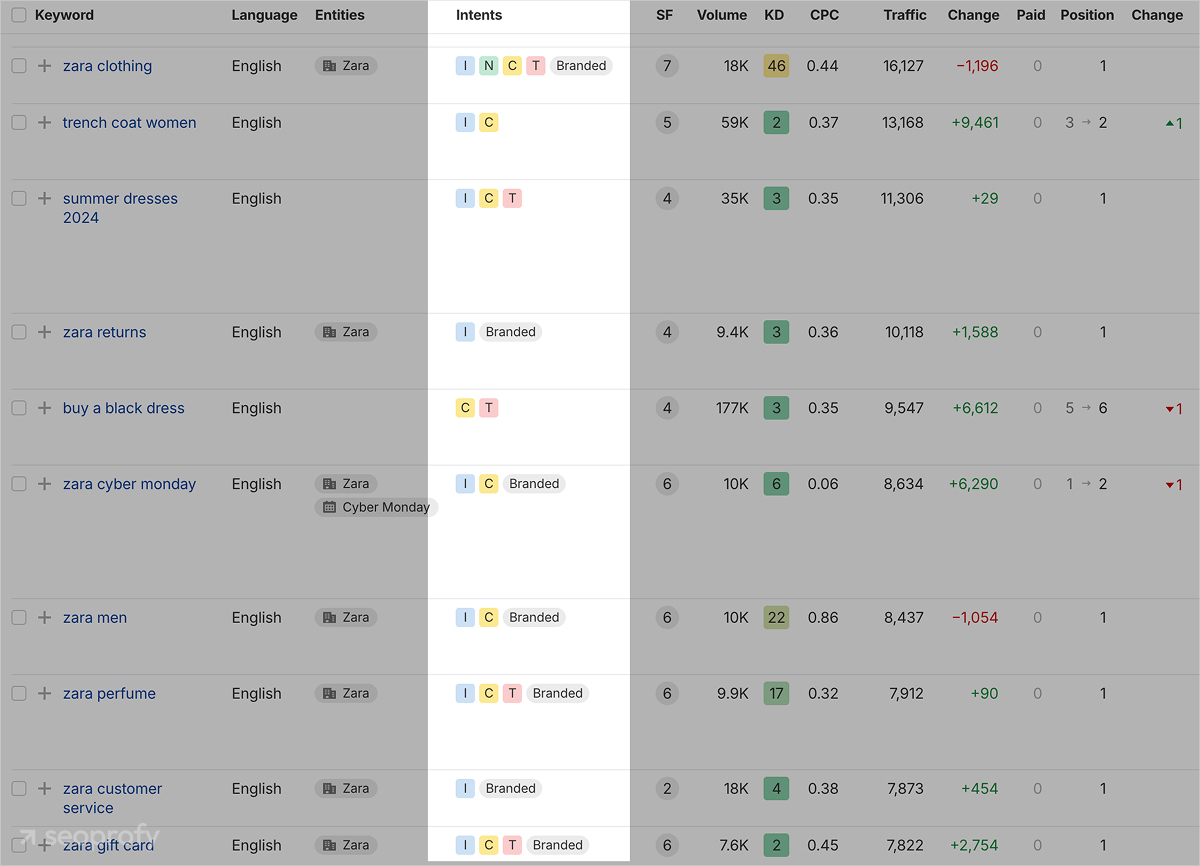
Enterprise companies typically operate across multiple markets, so keyword work must be done separately for each region because search intent rarely matches one-to-one. Take Zara as an example. In the US, search demand is concentrated around category-level queries like “trench coat women,” while branded queries make up roughly 11% of the queries that drive traffic.
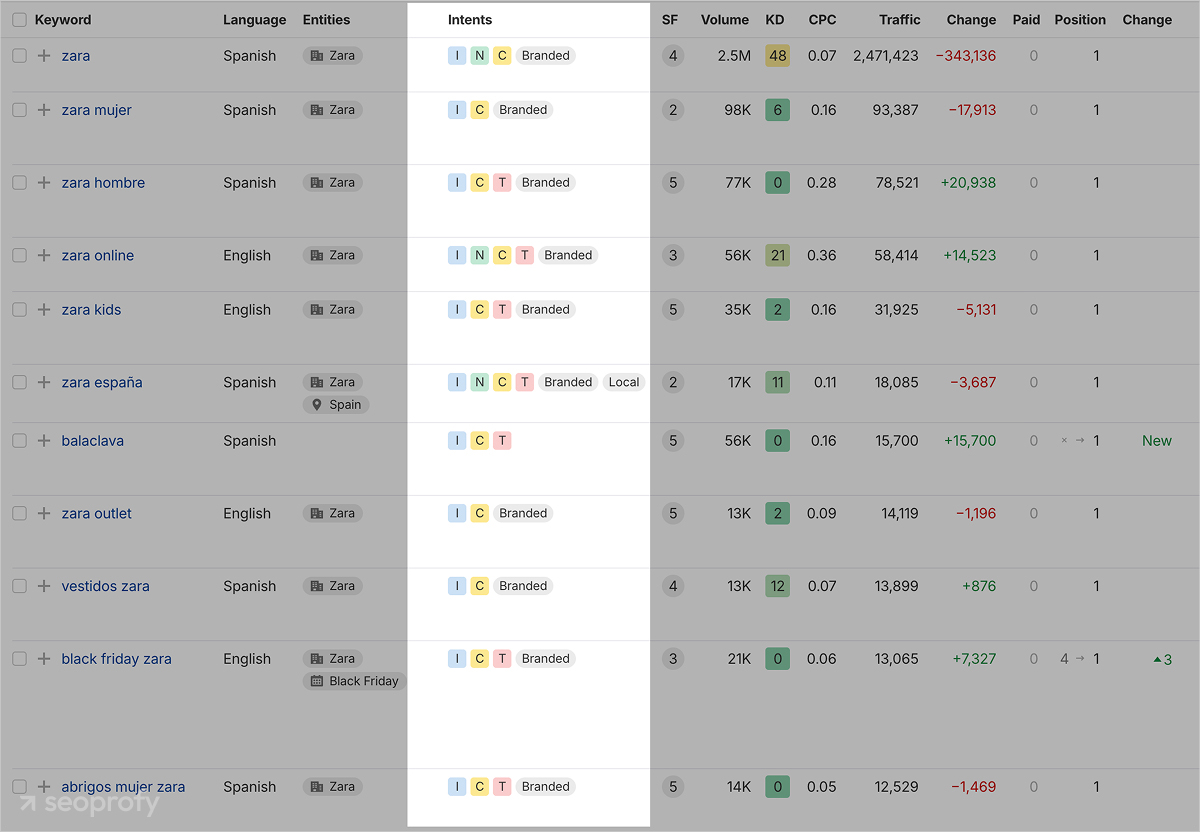
In Spain, demand is split between categories and brand or model-level searches, such as “vestidos Zara,” where 25%+ of the traffic-driving queries are branded.
Content Strategy and Large-Scale Content Production
Once the SEO professionals group your keywords and define which ones you should target first, they can start building the content strategy and producing content. In practice, the process includes:
- Content gap analysis to identify missing topics that competitors already cover
- Creation of landing pages aligned with specific keyword clusters, following with further on-page optimization
- Blog and informational content to support demand at different stages of intent
- Large-scale content updates to improve relevance and internal linking across existing pages.
Advanced Link Building & Digital PR
Backlinks are one of the three main ranking factors. So, to grow domain authority and give key pages a real chance to reach the top, agencies will always include link building strategies as part of the work. Because links for large brands carry reputational risk and often pass internal legal checks, teams rely on higher-cost approaches:
- Qualified outreach
- Digital PR campaigns
- Media mentions
- Collaboration with authoritative sources.
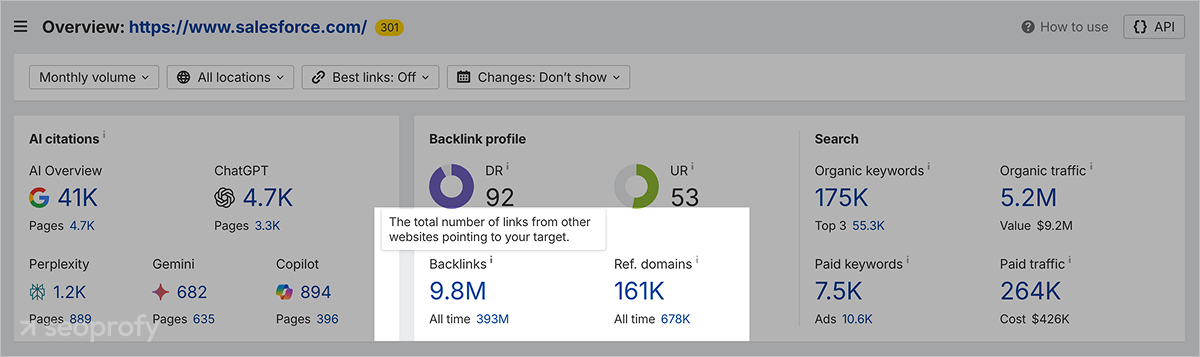
The enterprise SEO tactics also depend heavily on the product. A narrow compliance solution for a specific regulator usually allows more controlled and predictable link growth. A very different situation appears in broad enterprise categories where products compete with giants like Oracle or Salesforce, whose link profiles were built over decades through media coverage and industry mentions.
Matching that volume is difficult and, frankly, expensive. A single strong link often starts at $300, while competitors may already have thousands of them.
Conversion Rate Optimization (CRO)
CRO improves how users move from search to action. Over 33% of marketing leaders rank conversion rate among their top KPIs, which is why agencies often include CRO as a core service. Work usually includes:
- Fixing UX friction on key pages
- Testing page elements with A/B experiments
- Validating user paths from landing pages to conversion points.
Content is adjusted so users understand the offer faster and feel confident taking the next step. For large websites, CRO is applied to high-traffic templates and core funnels and requires coordination across design, development, analytics, and experimentation tools.
Analytics, Dashboards, and Reporting
At this scale, SEO data has to fit into how the business already tracks performance. Teams usually set up custom dashboards instead of relying on standard tools, connect organic performance metrics to BI systems, and follow how search supports leads, sign-ups, or sales.
Different teams need different views: marketing looks at demand, product checks page performance, and leadership cares about outcomes. Attribution helps show where SEO plays a role in the funnel.
SEO Automation and AI-Driven Efficiency Tools
In enterprise projects, automation and AI SEO tools are used to keep optimization under control as scale grows. Instead of checking everything by hand, the team sets up crawlers and automation to constantly scan the site, catch technical issues early, and track changes across thousands of pages.
The goal of this service is operational efficiency: lowering error risk and allowing specialists to focus on more advanced SEO decisions that move the project forward.
SeoProfy helps large brands grow organic traffic across markets without relying on short-term enterprise SEO solutions. Be ready to get:
- Multi-market SEO for complex site structures
- Search demand and intent mapping at enterprise scale
- Link building strategies for competitive niches
- SEO systems built for long-term growth

Why Invest in Enterprise SEO?
Enterprise SEO builds a channel you own. Once pages rank, they bring demand without paying for every click, which lowers customer acquisition costs over time. Organic traffic grows on top of existing results instead of resetting each month like paid ads.
Consistent visibility across category and solution queries also strengthens brand positioning, because users repeatedly see the brand when they research and compare options. Over time, this creates a competitive advantage that is hard to copy.
How to Choose the Right Enterprise SEO Partner
In the SEO industry, choosing a partner is a responsible decision, since large budgets and online business performance are at stake. Here’s what to pay attention to and what to watch out for.
Yes:
- Proven enterprise-level case studies with clear results
- Transparent processes and realistic timelines
- A structured team with defined roles, not a single “SEO person”
- Experience with large platforms, migrations, and multi-market setups
- Clear reporting on the results and SEO investment tied to business goals.
No:
- Guaranteed search results positions or traffic promises
- Vague explanations of strategy or execution
- One-size-fits-all enterprise SEO packages
- Lack of ownership or unclear accountability
- Tactics designed to manipulate search engine algorithms.
Final Thoughts: Making the Best ROI-Driven Decision for Enterprise SEO
Enterprise SEO comes with many challenges and edge cases. This is not something a small generalist agency can realistically manage at scale. So, the best ROI-driven decision for an enterprise business is choosing an SEO company with real experience that can take full responsibility for a complex project.
At SeoProfy, we bring over a decade of hands-on experience working with large, demanding projects. Our case studies speak louder than any promises we could make ourselves. We operate as a long-term partner, taking responsibility for structure, execution, and results.
Ready to discuss comprehensive SEO services at your scale?

As a Content writer at SeoProfy, Hanna Zhytnik creates SEO content grounded in research, data, and ongoing hypothesis testing. With more than 5 years of experience across B2B, SaaS, and ecommerce, she brings both breadth of knowledge and a sharp focus on modern search. Her strength lies in turning complex experiments into clear explanations, bridging the gap between deep SEO practice and accessible content.