


To rank higher on Google, build a sound tech foundation for a smooth user experience and mobile accessibility, create helpful, original content that addresses your audience’s search intent, optimize for relevant keywords, and develop a high-quality backlink profile and organic brand mentions.


Yet, knowing what matters is one thing; doing it is another. It’s not always clear where to start and which tactics truly move the needle for your rankings. In this article, we explain how to rank higher on Google and how exactly Google decides who to rank.
- Google uses automated systems to crawl, index, and rank pages based on hundreds of factors, not all of which it discloses.
- A slow, unstable, or hard-to-navigate site can hurt your rankings and user engagement, no matter how helpful your content is.
- Understanding why someone searches matters as much as understanding what they search.
- The E-E-A-T framework remains a cornerstone of Google’s ranking system in 2025.
- As generative AI is redefining search, your goal must also be to become one of the sources AI systems reference.
- If you’re a local business, focus on local search engine optimization to be visible to the right audience — nearby potential customers.
How Does Google Decide Which Pages Deserve to Rank?
Before we identify how to rank higher on Google, let’s understand how Google ranking actually works. It operates using completely automatic systems that crawl, index, and rank billions of web pages in seconds. It relies on numerous ranking factors to organize the results, which we then receive on the search engine results page (SERP). Although Google doesn’t reveal a complete list of these factors, it still shares guidelines about what it considers important:
- Google values “helpful, reliable, people-first content,” the kind that truly benefits users.
- It encourages creators to focus on user experience on their web pages, having introduced Core Web Vitals.
- Google’s “Search Essentials” lists technical requirements, spam policies you should avoid, and best practices like making links crawlable.
Of course, these are only some of the resources that explain how to rank higher on Google. Based on our experience working daily with Google guidelines and managing SEO campaigns for our clients, we can point out the most significant factors that usually determine if websites achieve good rankings and increase organic traffic in 2026:
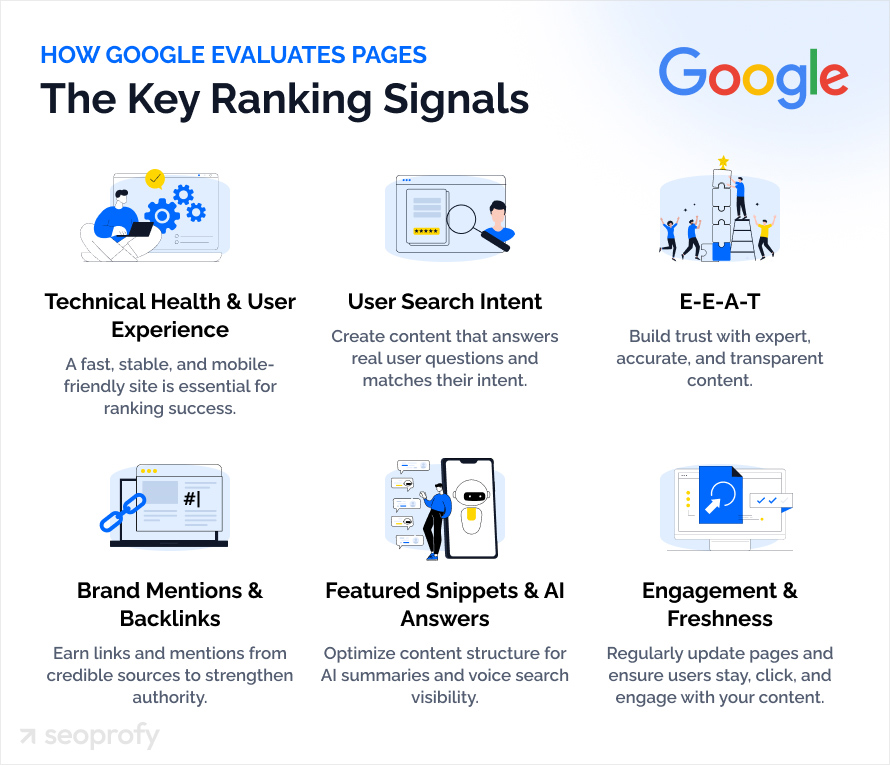
- Technical health and user experience. This must be a top priority, as even the most interesting article may struggle to perform well on a website with a poor page speed.
- User search intent. Google serves pages that satisfy the reason someone searches. When you write a particular piece of content, you should understand who you are writing for. Some users want to make a purchase or schedule a consultation. Others are only exploring their options.
- E-E-A-T. After you’ve developed a content strategy in line with what your target audience expects, the next thing to consider is why they should actually trust you. This is where E-E-A-T (Experience, Expertise, Authoritativeness, Trustworthiness) comes in. While not a direct ranking factor, it reflects the kind of quality Google’s systems are designed to reward.
- Brand mentions beyond links. A rich backlink profile matters for your rankings, but to make sure you stay visible, you should also aim for organic mentions in industry media, directories, and forums.
- AI featured snippet and answer generation. Next, we have the major change in recent years — AI search. Suddenly, your competitors’ websites aren’t the only search competitors; it’s ChatGPT and Google itself summarizing answers. The good news is that these summaries still pull from the internet. With the right approach, you can become one of the sources that AI references.
This was a quick look at the big picture. Now, let’s explore how to improve Google rankings in detail.
Improve Technical SEO and User Experience
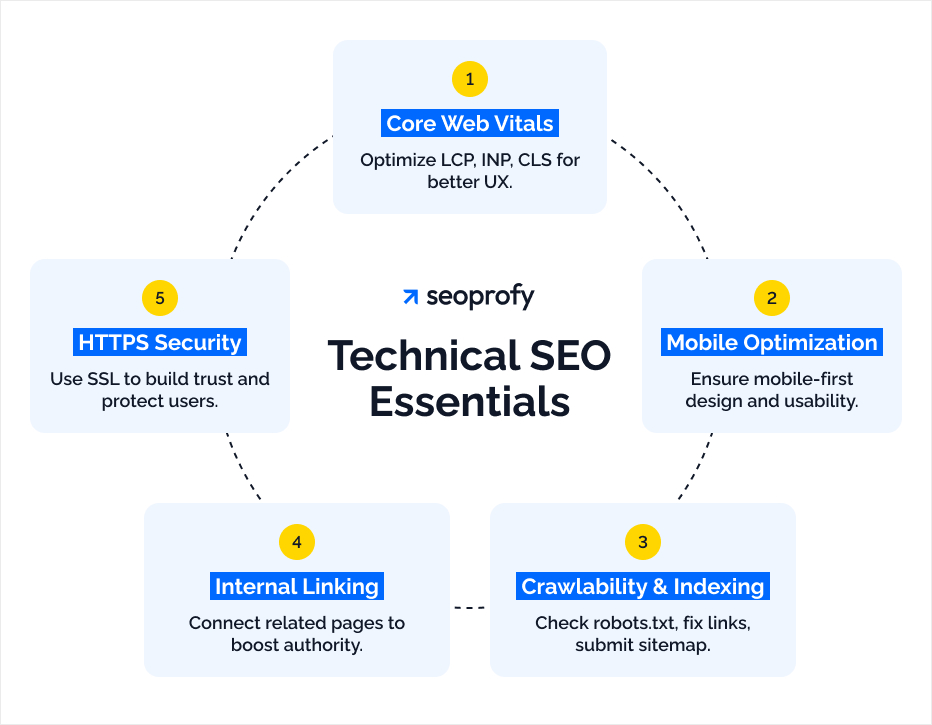
Multiple technical factors affect rankings behind the scenes, and most of them can be measured and improved. If you wonder how to rank higher on Google, you should start with a technical SEO strategy. Here are some of the main steps it must consist of.
Refine Core Web Vitals
Google measures user experience through several signals called Core Web Vitals. Here are some of them:
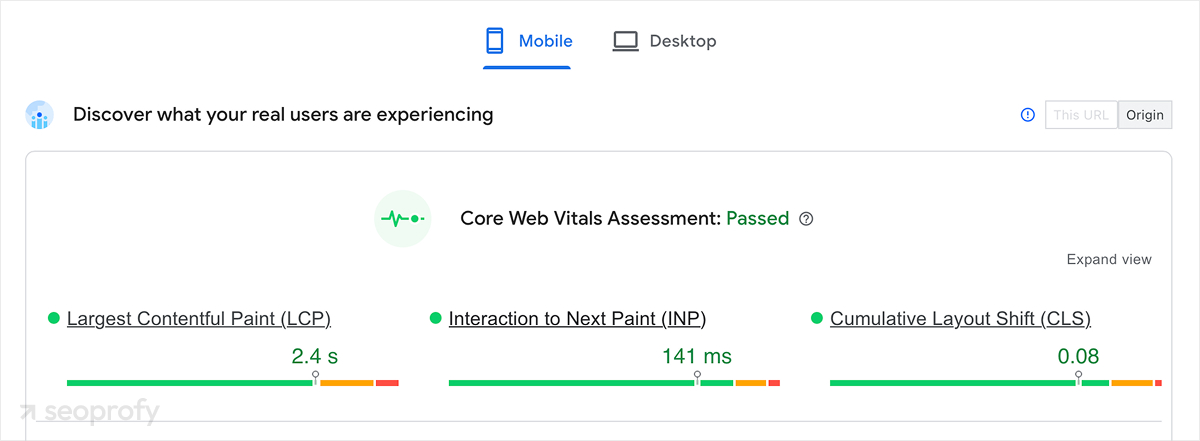
- Largest Contentful Paint (LCP) checks how fast the main part of your page appears.
- Interaction to Next Paint (INP) measures how quickly your website responds when users interact with it.
- Cumulative Layout Shift (CLS) evaluates how stable your layout is during page loading.
If your website has a bad loading speed, or if the images move around while the page is appearing, this can frustrate users and, thus, negatively impact your positions in Google search results. To avoid this scenario, use Google PageSpeed Insights — it will show you how your website performs and indicate what needs fixing. This is what a Core Web Vitals assessment looks like in Google PageSpeed Insights:
Make Your Website Mobile-Friendly
The majority of people (63%) use a mobile device to research brands and products. Plus, Google uses mobile-first indexing, which means your entire site’s performance partly depends on the mobile user experience. Here are some tips to make your website mobile-friendly and increase Google ranking:
- Avoid small buttons, excessive pop-ups, and similar issues that may frustrate mobile users.
- Use identical robots meta tags for your mobile and desktop pages.
- Ensure your mobile and desktop versions include the same structured data.
- Display your mobile ads in line with the Better Ads Standards.

Ensure Google Can Index and Crawl Your Pages
No successful SEO strategy can work without this aspect. If Google can’t access your pages, they don’t exist, at least not in search results. Check robots.txt, fix broken links, and submit sitemaps to make sure all essential pages, especially revenue-generating ones, are visible to Google. Search Console or ScreamingFrog can assist you with this task.
Build a Clear Site Structure with Helpful Internal Links
Internal links, the ones connecting your own pages, strengthen topical authority. They show how your content is organized and point to the pages you want to rank highest, like your main services.
Also, internal linking keeps visitors engaged. For instance, if you link a service page to a related blog article, this may encourage them to explore more to better understand the value of your offering.
Use HTTPS for Security and Trust
Visitors are more likely to trust HTTPS websites, those where the connection is encrypted and their data is safe. Additionally, this tells Google your site offers a secure browsing experience.
Create Content That Google Wants to Rank
When technical issues are sorted out, you can proceed with the more creative part of your SEO campaign — content creation. A key principle for creating content that ranks well in SERP is to follow Google’s E-E-A-T framework. Your content should demonstrate the following aspects:
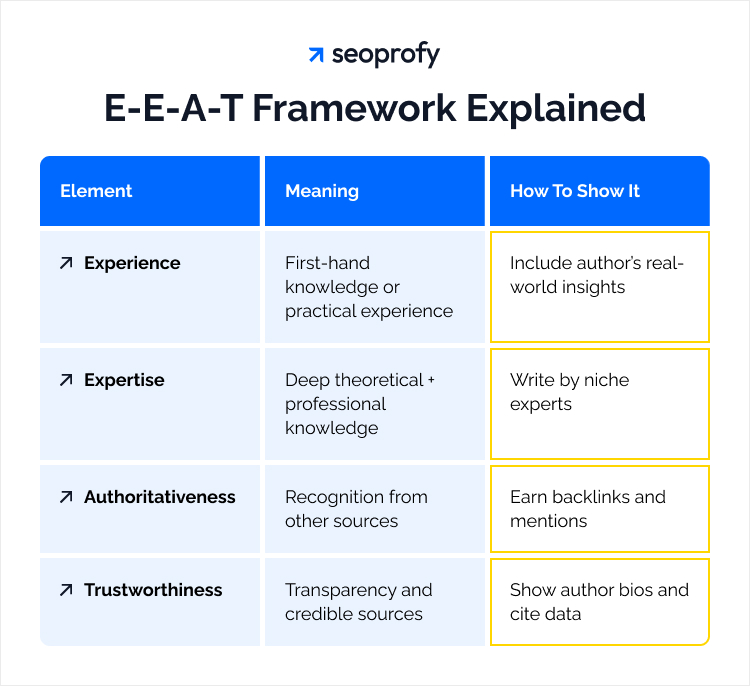
- Experience means your content was written by someone with first-hand knowledge of the topic.
- Expertise shows the author has not only first-hand knowledge in the field, but also theoretical knowledge, the theory behind it.
- Authoritativeness means other websites recognize the author or brand as a trusted source.
- Trustworthiness comes from transparency: you specify who the author of your content is and back it with credible sources.
For instance, to prove your expertise, you could add the author section to each article, highlighting the writer’s professional background and experience. Here’s an example of such an author section that we at SeoProfy add to our articles:

Ensuring relevance and correspondence to user search intent through keyword optimization is also very important. Below are some other quality content creation principles that can help you reach the first page.
Choose the Best Content Format for the Topic and Research Target Keyword
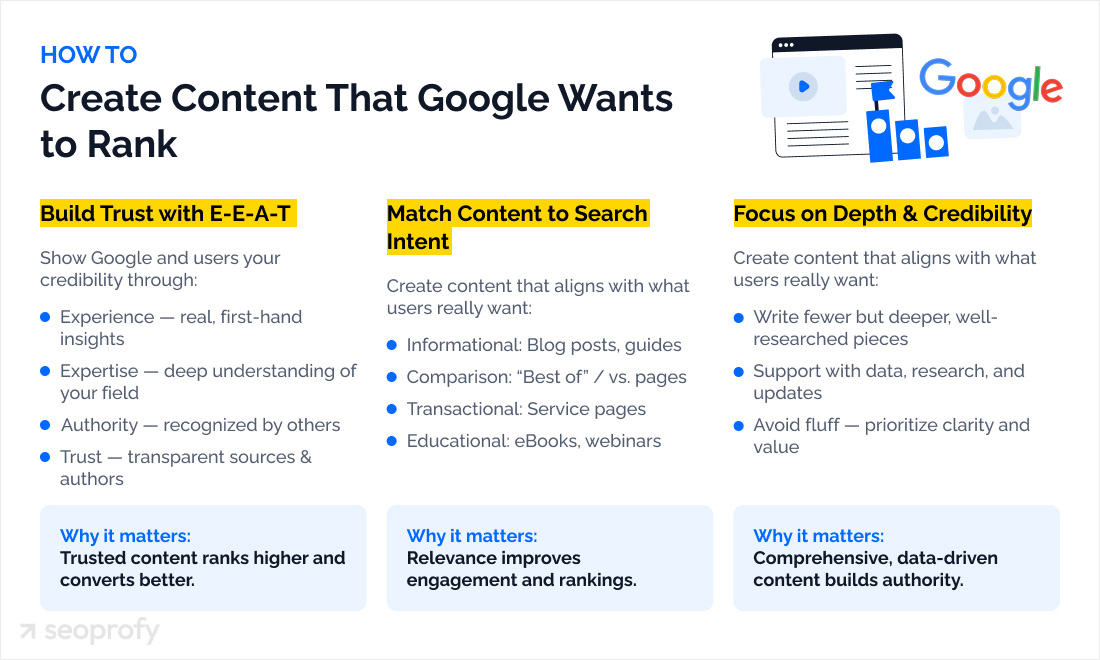
While prioritizing ready-to-convert users may feel logical, educating those still discovering their options is just as vital, since more than half of all searches are made by people simply looking for information. For lead nurturing, pick educational blog posts. To target those closer to making a decision, consider creating comparison articles and service pages.
Then, you need to identify relevant keywords that reflect how people search. Tools like Google Keyword Planner and Ahrefs (or SEMrush) will help you see what topics and phrases have real demand.
Go Deep on Your Topic Instead of Going Wide
Instead of writing ten short posts that only skim the surface, it’s much better to focus on one or two that answer practical questions and solve real problems. This will make website visitors actually read what you wrote, increasing their time spent on one page. Google may interpret this as a sign that your content is indeed highly relevant and display it more often in results next time.
Back Up Your Content with Research Data
This is one of the ways you can strengthen your E-E-A-T signals. When creating content, back your ideas with relevant research data, whether third-party or your own, so that your article is grounded in facts. Users must be able to verify the information you share. Plus, regularly update your articles with the most recent information to ensure content freshness and accuracy. Users must be able to verify the information you share and be confident it’s up to date.
We’ll create an actionable SEO plan you can put into action right away to reach the following goals:
- Top ranking on Google
- Qualified organic traffic
- Content that converts
- Long-term SEO stability

Publish Content Optimized for User Satisfaction Signals
Satisfaction signals reflect whether your content addresses your clients’ needs. Previously, we’ve already mentioned one user satisfaction signal — the time spent on a page. Some other signals are:
- Bounce rate
- Scroll depth
- Pages visited per session
- Social shares or saves
- Bounce rate
- Return visits
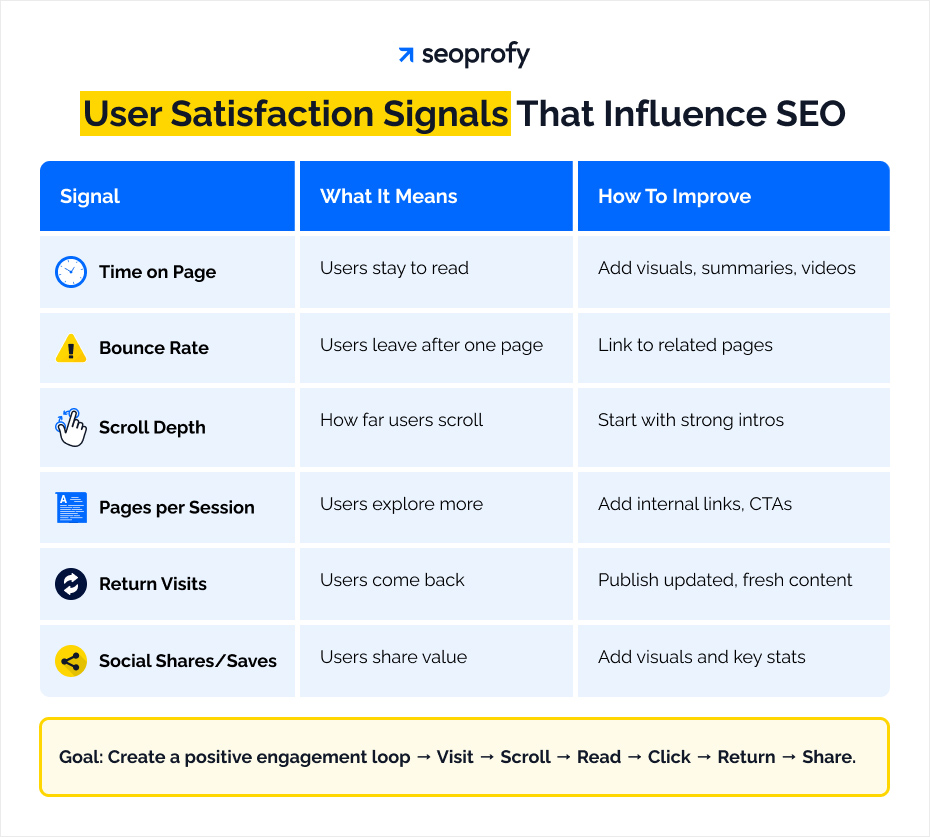
Necessary to specify that time spent on a page isn’t a ranking factor itself, as it can actually be misleading — users might just quickly find the answer and leave. Yet, together, these signals may create particular patterns, and algorithms do rely on them when deciding which pages deserve ranking high on search engines.
So, the task is to create a positive engagement pattern: users visit your page > scroll through > pause to read > click on related pages > come back later > share links to your pages.
Here are some tips and tricks on how to get a higher ranking on Google.
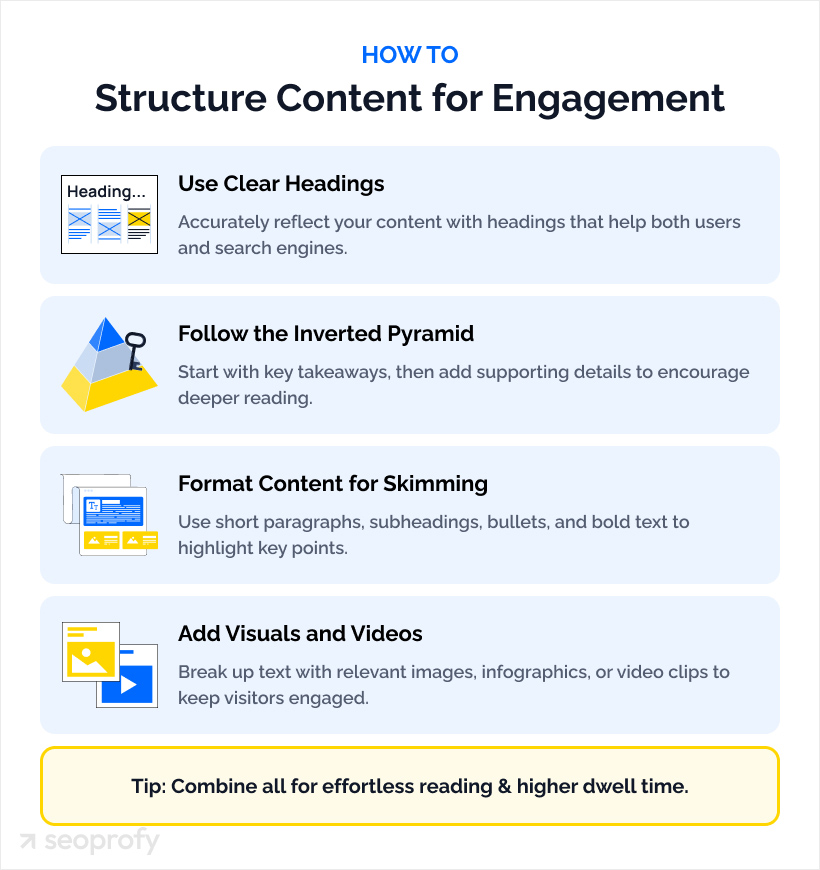
Use Clear Headings That Match the Content
Use headings that accurately reflect the content that follows. Similarly, it shows people whether your pages are relevant to them. Plus, this allows Google to identify which questions and topics your page covers and determine how well it matches a user’s search intent.
Follow the Inverted Pyramid Structure
The inverted pyramid is an approach where you start with the most important information and then move to supporting details. For instance, you might add key takeaways at the beginning of the article. This way, you’ll let your visitors see that your content does answer their question and motivate them to read the rest. You can also add jump links to let people go directly to the section they’re most interested in.
Format Content for Effortless Skimming
Some people don’t read word by word but rather skim to find what matters to them. To simplify this task, you could use:
- Short, easy-to-read bursts
- Subheadings to organize thoughts clearly
- Bullet points to group information
- Bold text to highlight key takeaways
Add Visuals and Video Content
Visual elements are another method to break up text and make your content more readable. Plus, as you include infographics or screenshots, people may stop and take a closer look. Also, a relevant YouTube clip, especially one from your own channel, gives users a reason to pause and stay on the page a little longer. Most advanced SEO strategies use this trick.
Strengthen Your Authority with Link Building and Mentions
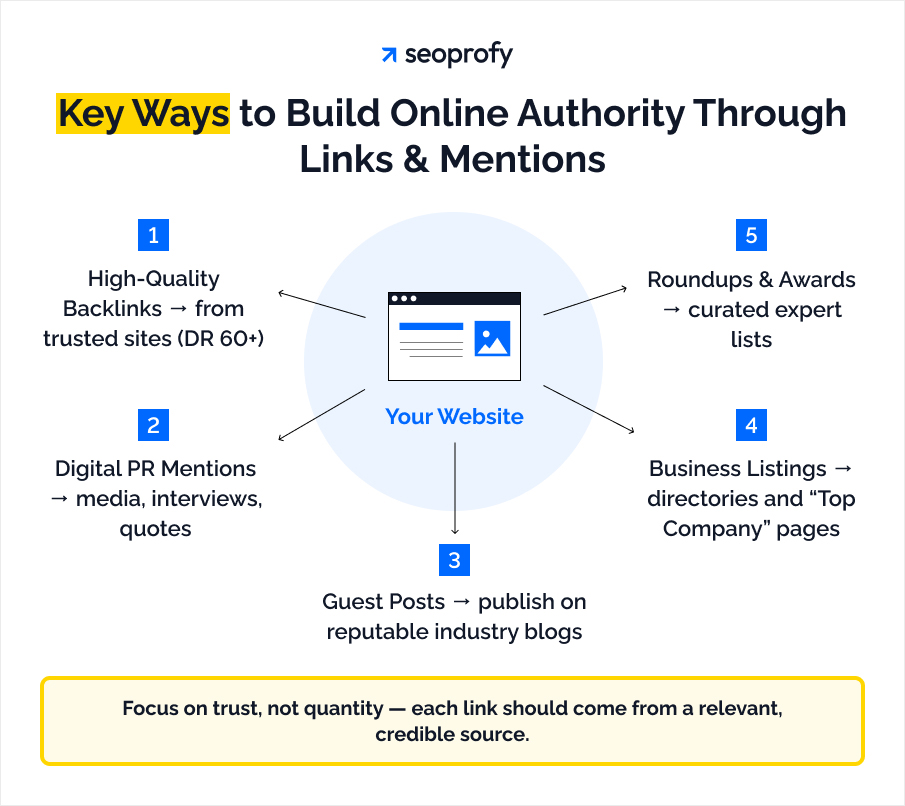
Your SEO efforts shouldn’t stop on your website only, as Google assesses how your brand is recognized across the web, too. Backlinks, or inbound links, and mentions strengthen your perceived authority and trustworthiness — key components of the E-E-A-T signals. Here’s how to improve Google search ranking by building these ranking signals naturally.
Earn High-Quality Backlinks
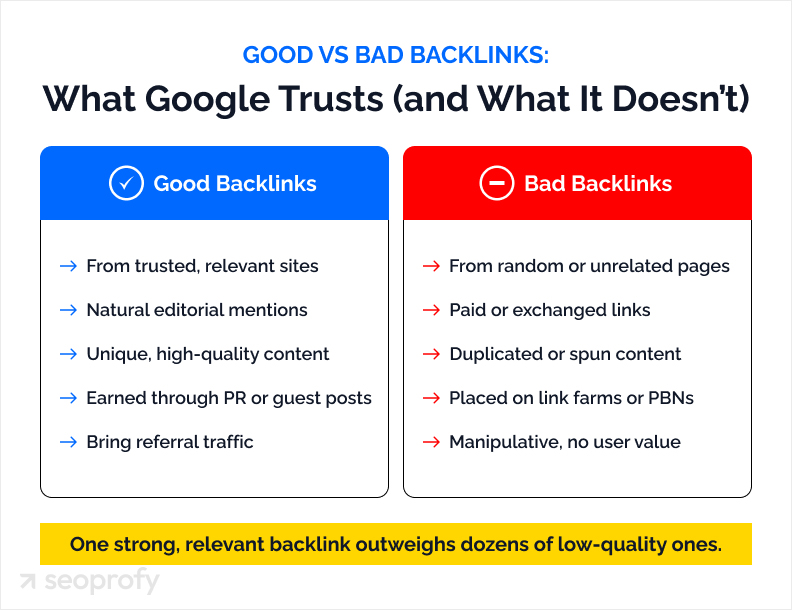
The quantity of websites that link to you is important, but what else is critical is the origin of these links. Prioritize trustworthy sources with a good domain rating (ideally 60 and above), as this will benefit your domain authority.
Because if you do link building for the sake of it, collecting links from questionable sites, like link farms (websites created solely to sell or exchange backlinks), you risk being penalized for ranking manipulation and ranking worse. If you want to make sure your link-building strategy won’t negatively impact your rankings, SeoProfy knows how to do link building the right way.
Use Digital PR and Guest Posting to Build Links
Digital PR is one of the most effective ways to earn links and mentions naturally. You could arrange an interview with an online magazine and reach out to other website owners and contribute quotes to their expert articles.
Another method to rank high and get more organic traffic is guest posting, where you write content for another website in exchange for a link back. Search for “write for us” or “guest contributor” pages in your niche, and you’ll be offered multiple results. Here are the first two options that show up first if we search for “write for us lawyers:”
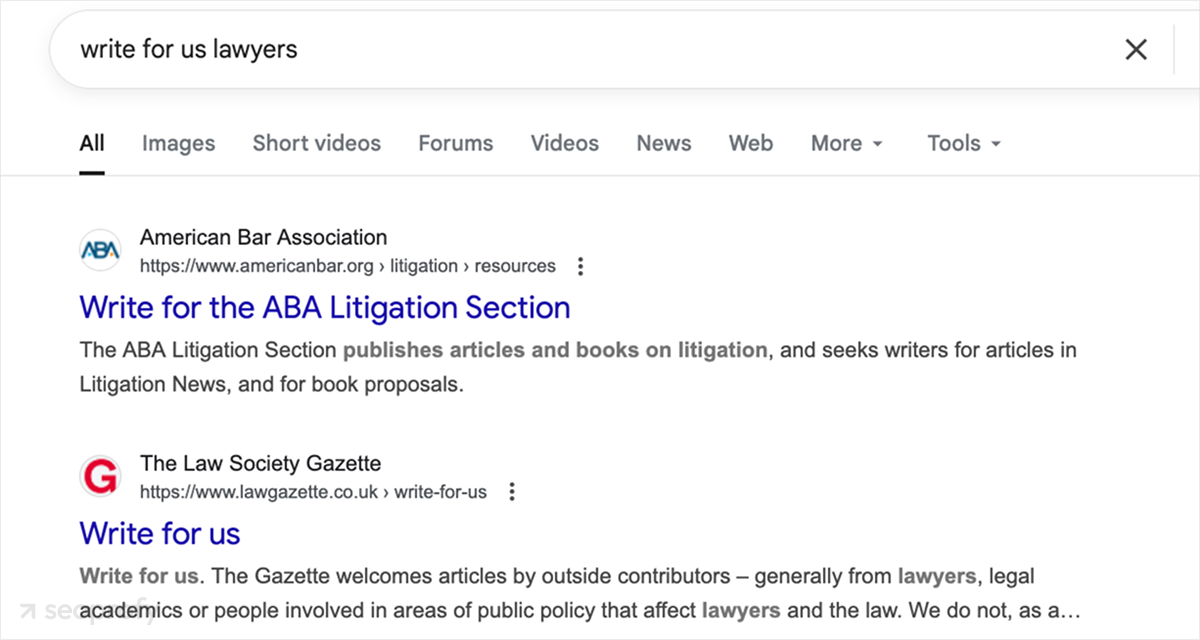
Just make sure these sites aren’t created solely for guest posts, as they should have their own audience and real value. The American Bar Association and the Law Society Gazette, from the screenshot above, look exactly like such sources, as both are well-established organizations in the legal field with strong editorial standards.
Get Featured in Listings and Roundups
You can also earn valuable mentions by appearing in business directories or “Top Company” roundups. These pages often attract strong organic traffic and are trusted by both users and Google.
Do Local SEO
For businesses that sell or provide services locally, like law firms or dental clinics, an SEO strategy will look a bit different from companies that operate globally, such as SaaS platforms.
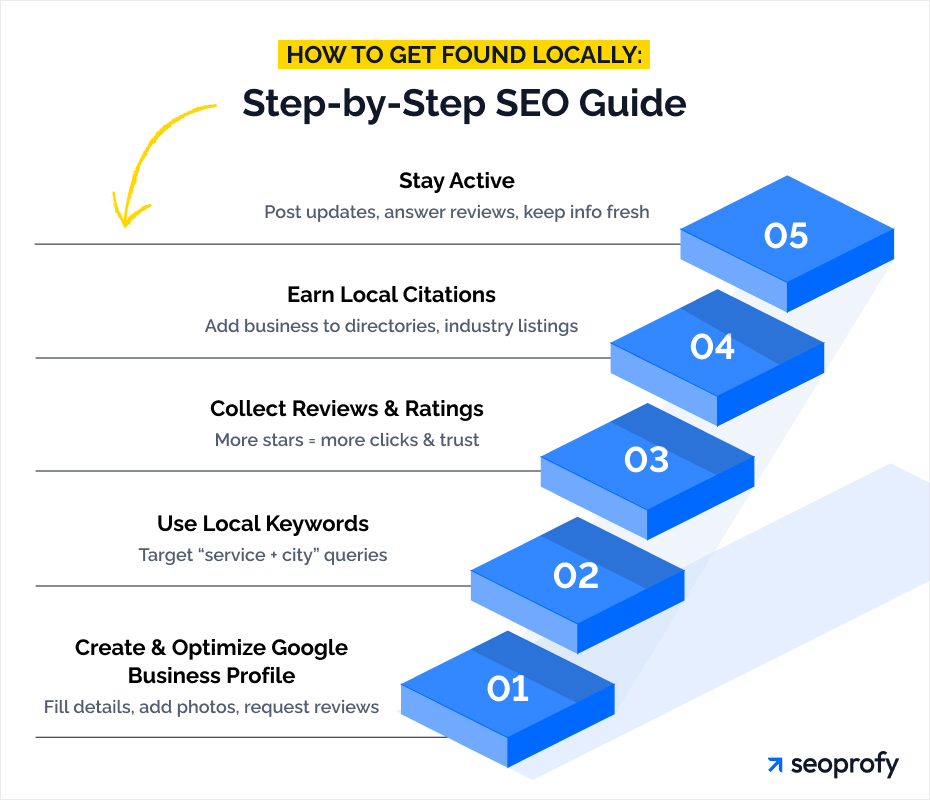
Such businesses need local SEO. It means optimizing your online presence so people nearby can easily find your business. Here’s how to rank higher on Google if you’re a local business.
Optimize Your Google Business Profile
When people search for businesses nearby, they often see a local pack, a section that appears at the top of Google’s search results. Here’s the local pack provided by Google if you search for “best roofing companies in Dallas:”
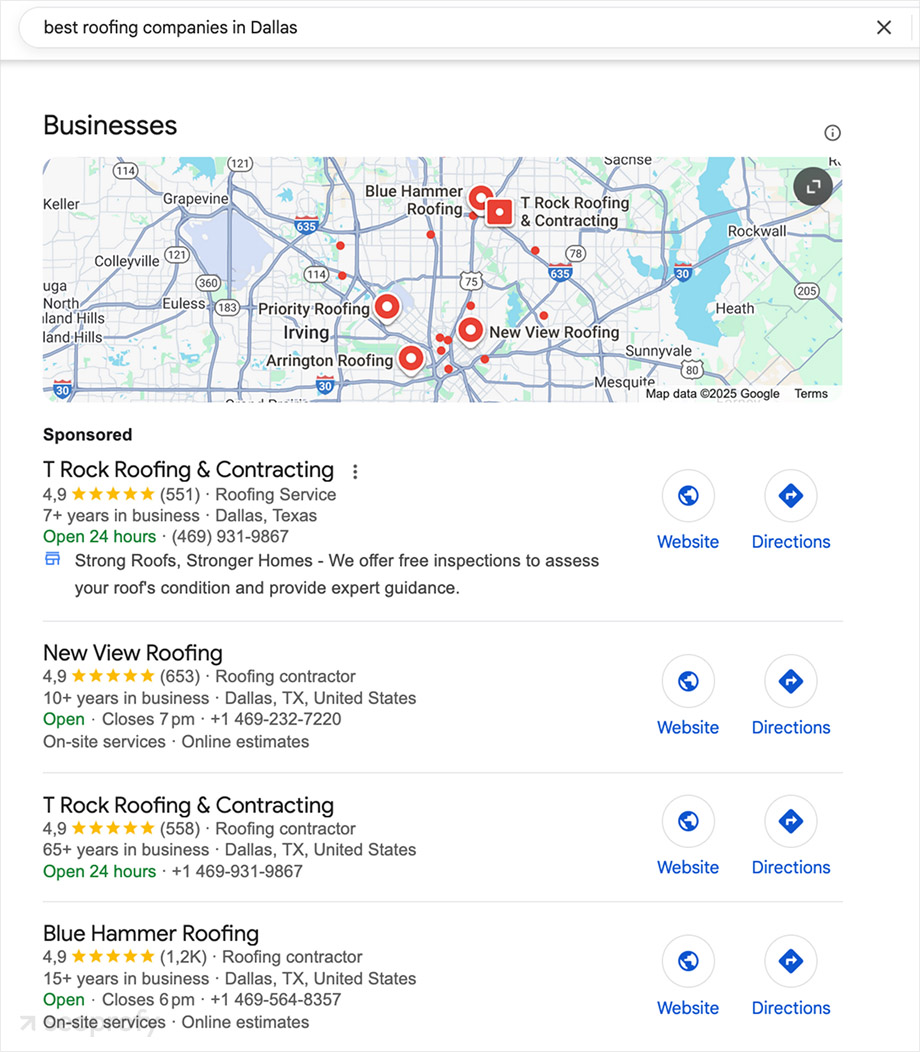
Getting featured there matters because some users may not scroll past it. To get into this section, you should first create and then optimize your Google Business Profile:
- Fill in all core details: address, phone number, business hours, and website.
- Select the most accurate business category.
- Add photos of your location and a team.
- Ask satisfied customers to leave reviews.
The more complete and active your profile is, the more confidence Google has to show your business to nearby users.
Use Local Keywords to Target Your Area
Local keyword research is another aspect of an effective SEO strategy. Local long-tail keywords, like “roof repair in Dallas” or “wedding photographer in Boston,” indicate the exact area where you operate, helping Google match your business with people nearby. To find these keywords, you can use Google Keyword Planner or some paid SEO tools, like Ahrefs.
Collect Local Reviews and Citations
A business with many recent, positive reviews often appears higher in the local results. Plus, numerous five-star reviews attract more clicks and calls from potential customers.
In the same way, citations let you achieve strong local SEO results. These are third-party online mentions of your business’s key details. Citations help Google confirm that your business is active, so it can confidently display your website. Here are some ideas where you can get local citations to boost your Google ranking:
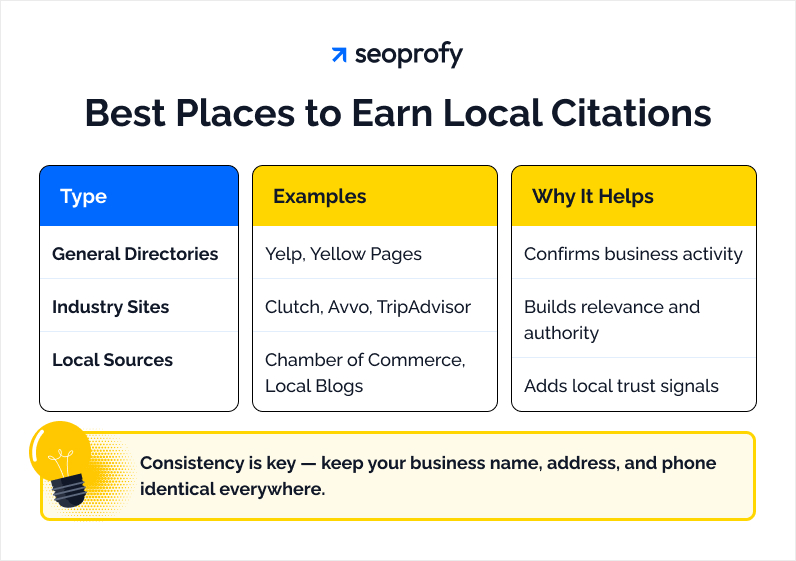
- Business directories like Yelp and Yellow Pages
- Industry-specific listings such as Clutch, Avvo, or TripAdvisor
- Local chambers of commerce or professional associations
Adapt Your SEO Strategy to AI and LLMs in 2026

With 21% of respondents citing it, generative AI has become one of the most significant factors impacting SEO performance today. Tools like Google’s Search Generative Experience (SGE), AI Overviews, and conversational LLMs such as ChatGPT now take some part of user attention for themselves. Instead of visiting several websites, people can get direct answers right on the results page.
Or they may head straight to ChatGPT to find the necessary information. For instance, someone might ask, “What are the best SEO companies in the US?” and receive a short list of agencies that offer expert SEO services. Here’s what it would look like:
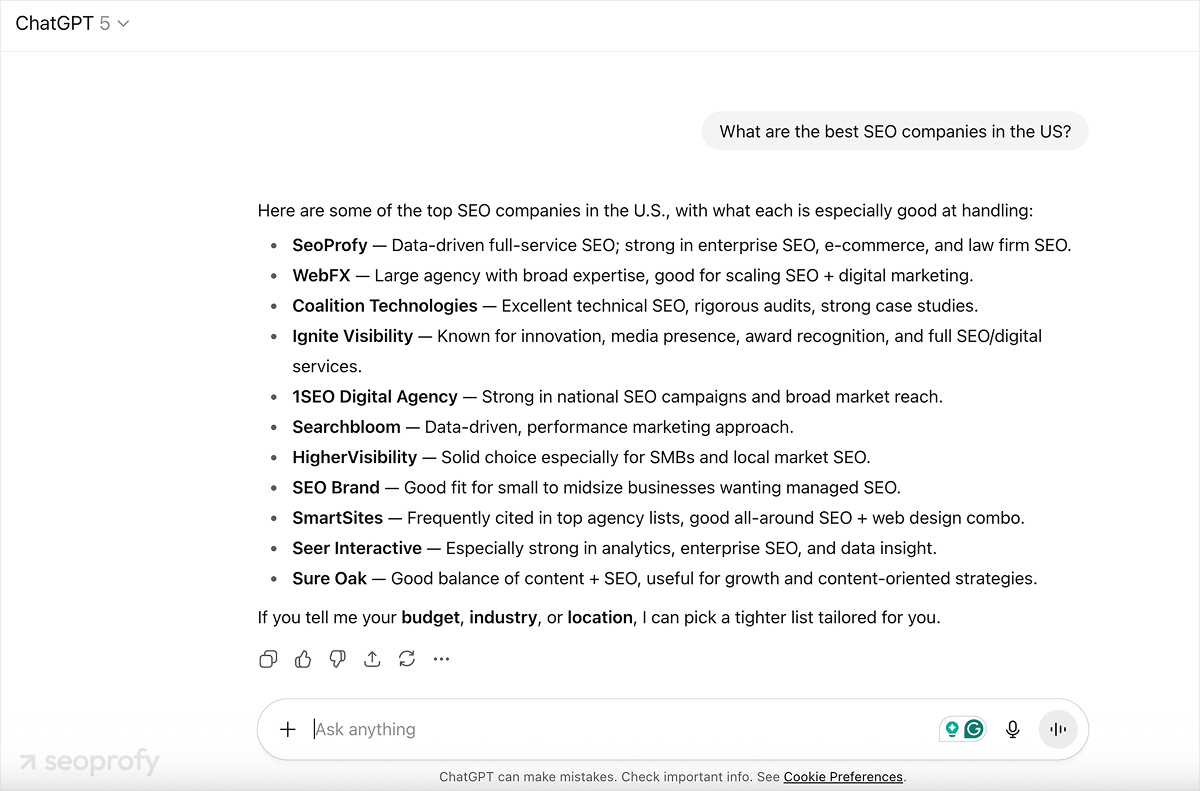
These tools still rely on existing websites and provide links to the sources they use. This means your content can still appear there and bring traffic. Although LLM SEO is a comparatively new discipline and is still actively researched, we’ve already discovered some methods to get cited by AI.
Add Schema Markup
AI systems don’t see the pages as humans do, so they rely on schema markup to interpret the structure of your page and pull the right information. It’s a type of structured data, small pieces of code added to pages, that indicate to bots what your content represents. For instance, it can show whether a page contains a product with a price, an article with an author, or a local business with an address.
Create Content in a Q&A Format
AI systems are built to recognize and respond to questions, and that’s what they were trained for. If you structure your content in the format of questions and answers, you make it easier for AI to understand what your page answers and match it with relevant search queries. For instance, you might use titles like “What is…” or “How to…” and give a straightforward answer right under it.
Build Trust with E-E-A-T Principles
When it comes to LLM SEO, the principle stays the same—your website content must be useful and credible, or, in other words, correspond to the E-E-A-T framework. AI systems use similar signals when deciding which sources to rely on for answer generation. They prioritize sources that consistently demonstrate high data accuracy and are frequently cited by other sources. This reduces the risk of providing inaccurate information.
Repurpose Content
AI systems learn from a wide range of online sources, like articles, videos, forums, reviews, podcasts, and social posts. So, it’s worth appearing across all of these sources to increase the chances of being mentioned by AI in its replies. You can turn a blog post into a YouTube explainer, a LinkedIn post, or a Quora answer. Each version will reinforce your message and help AI gradually recognize your brand as a trusted source of information with fresh content.
Wondering How to Rank Higher on Google? We Have the Answer
These are the core strategies that have consistently proven to work across dozens of our client projects. With this approach, our professional company has helped businesses secure top positions on Google and achieve significant, measurable growth in organic traffic and ROI.
No need to guess how to rank better on Google anymore. Whether your goal is to optimize a new site or upgrade an existing one, contact us for a custom SEO strategy to boost website ranking!

Andrew Shum is the Head of SEO at SeoProfy with 10+ years of experience in SEO and digital marketing. He has been part of the company for over 6 years and has led the SEO department for the past 3.5 years, managing a team of 15+ specialists. He works with competitive and international multi-language projects across eCommerce, SaaS, and enterprise niches, focusing on practical SEO strategies that deliver measurable results.