

Ecommerce digital marketing is the process of promoting an online store across multiple digital channels, including organic and paid. While the ecommerce platform handles transactions, marketing creates demand. In practice, this includes content-led acquisition, personalization, affiliate partnerships, and conversion optimization to increase sales, visibility, and loyalty.


In SeoProfy’s case study vault, we have many successful ecommerce projects of different sizes. At this point, we know which strategies pull their weight. That’s why we decided to break down the specifics of digital marketing for this niche and share a concrete, working framework. If you’re planning to grow an ecommerce project in 2026, this article is your destination.
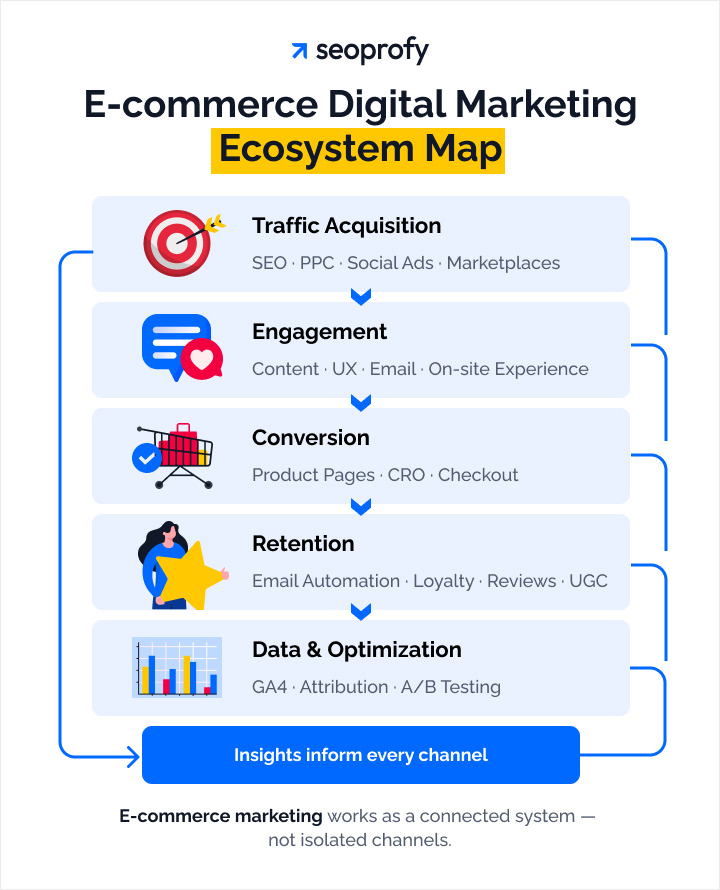
- Ecommerce digital marketing works best as a connected system. SEO, PPC, social, content, email, and measurement should reinforce each other instead of living in silos.
- SEO remains one of the strongest long-game channels for ecommerce. It compounds over time and can outperform paid traffic on ROI once it gains traction. Paid media brings speed, but it demands tight control.
- The most reliable growth comes from iteration. Track the right KPIs, run tests, refine based on data, and keep improving the system instead of chasing one-off wins.
What Is Ecommerce Digital Marketing?
Ecommerce digital marketing is the system that makes an ecommerce business visible, competitive, and commercially viable across digital channels. It covers how people find a store, why they choose it, and what brings them back.
An online store can exist, have a decent design, and even work perfectly from a technical standpoint, yet still sit on page 35 of search results for priority queries, remain unknown to its audience, and generate no revenue despite serious investments in development and inventory. In most cases, this is not a product issue. It’s a visibility and demand issue.
That gap is addressed by digital marketing. It brings together SEO, paid advertising, social media, and now GEO, because discovery no longer happens only through classic search results. Global ecommerce sales exceeded 6 trillion dollars in 2025, and nearly 60% of US shoppers already use AI tools like ChatGPT or Gemini to assist with purchase decisions.
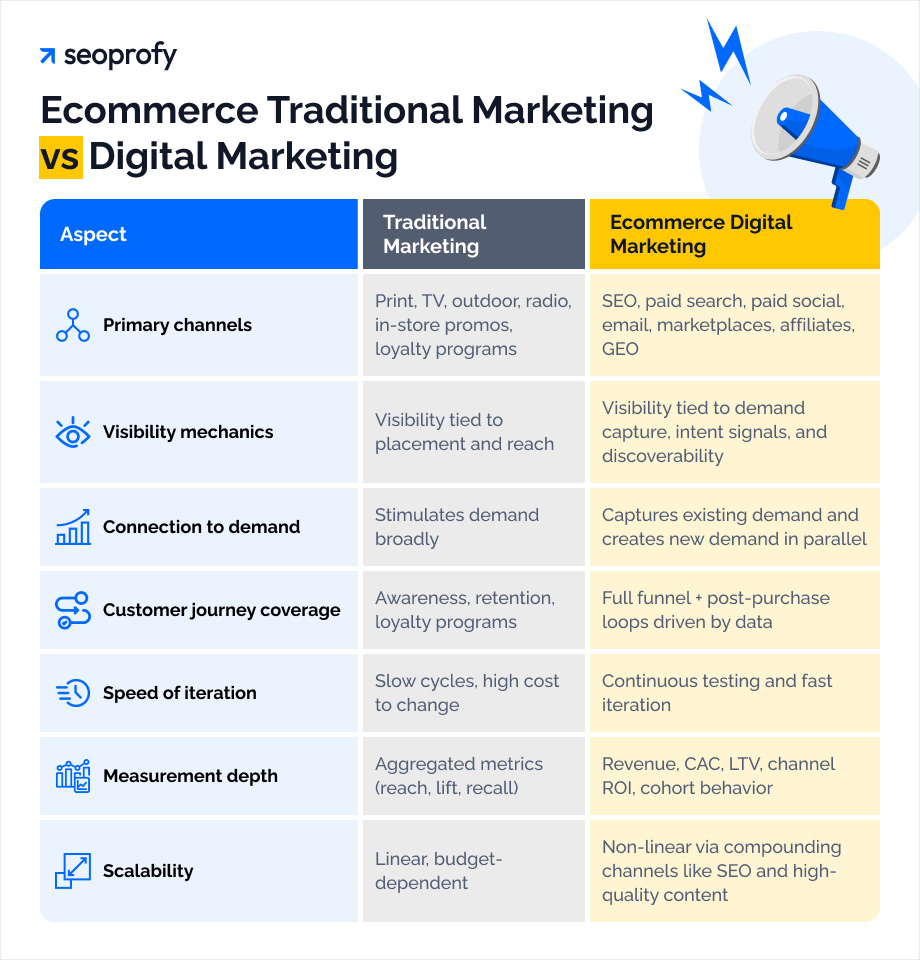
The more channels are actively working together, the broader and more resilient the reach becomes. That’s why traditional marketing on its own is no longer sufficient heading into 2026. Below is a clear comparison showing how these approaches differ in practice.
| Ecommerce Traditional Marketing vs Digital Marketing | ||
|---|---|---|
|
Aspect |
Traditional Marketing |
Ecommerce Digital Marketing |
| Primary channels | Print, TV, outdoor, radio, in-store promos, loyalty programs | SEO, paid search, paid social, email, marketplaces, affiliates, GEO |
| Visibility mechanics | Visibility tied to placement and reach | Visibility tied to demand capture, intent signals, and discoverability |
| Connection to demand | Stimulates demand broadly | Captures existing demand and creates new demand in parallel |
| Customer journey coverage | Awareness, retention, loyalty programs | Full funnel + post-purchase loops driven by data |
| Speed of iteration | Slow cycles, high cost to change | Continuous testing and fast iteration |
| Measurement depth | Aggregated metrics (reach, lift, recall) | Revenue, CAC, LTV, channel ROI, cohort behavior |
| Scalability | Linear, budget-dependent | Non-linear via compounding channels like SEO and high-quality content |
Core Channels and Strategies for Ecommerce Marketing
Now we move from theory to the practical part. Here we cover everything ecommerce digital marketing is built on: the core strategies, approaches, and channels. This is the foundation you need before we move on to the step-by-step framework.
Search Engine Optimization (SEO)
SEO is the process of making an ecommerce site discoverable at the exact moment a user is looking for a product, comparison, or solution. It focuses on how product and category pages appear in search, how well they match real buyer intent, and how clearly search engines understand what is being sold, to whom, and in what context.
This matters because 59% of potential customers use Google to find information about products they plan to purchase, making search one of the most reliable acquisition channels for ecommerce. Moreover, search optimization is also one of the highest-ROI channels available. More than 91% of marketers report that SEO positively impacts website performance and marketing goals.
While initial investment can feel heavy ($1,500 – $20,000/month according to our study) and early movement usually appears only after 4–6 months, search engine marketing campaigns typically reach a positive ROI within 6–12 months. Compared to its closest alternative, paid search, SEO delivers significantly stronger returns: an average 8× ROI, versus roughly 4× for PPC, based on data from 119 companies.
And the best part: unlike paid channels, search optimization efforts compound. Once strong positions are established, pages continue generating traffic and being amazing lead gen tactics even after active optimization slows down. That makes SEO an incredible long-term asset.
Here’s what ecommerce SEO includes:
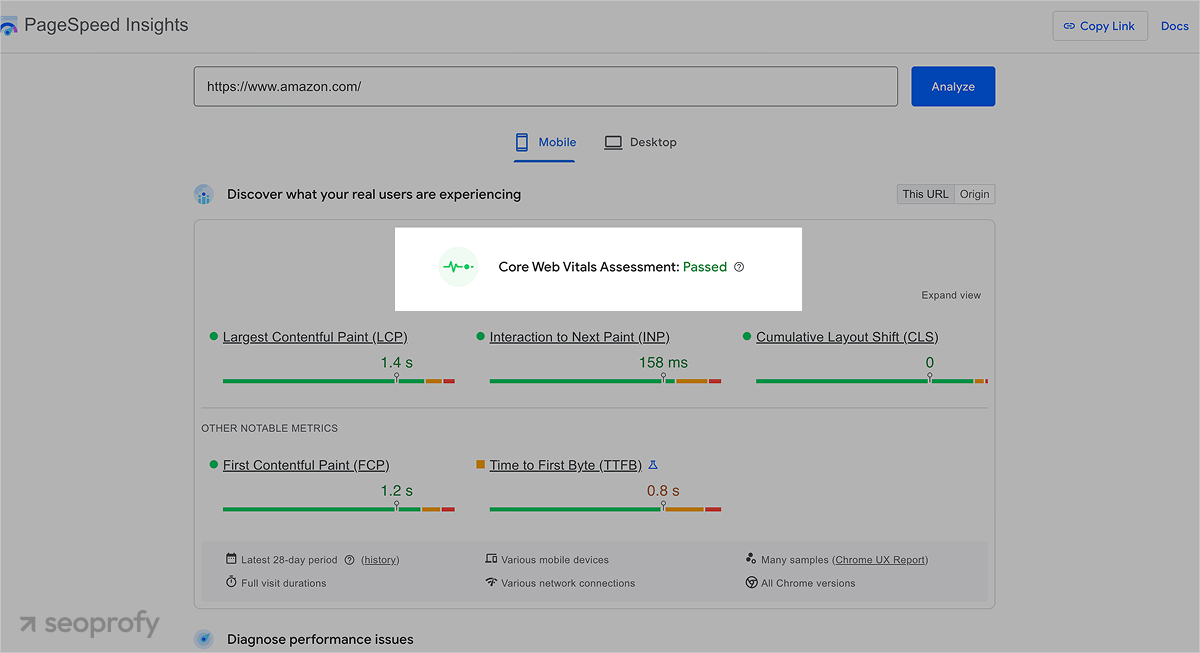
- Technical optimization: This is the foundation. It covers crawlability, indexation, site speed, mobile performance, structured data, pagination, faceted navigation, canonical logic, and Core Web Vitals. Technical SEO ensures search engines can reliably access, understand, and prioritize the right pages without noise or duplication.
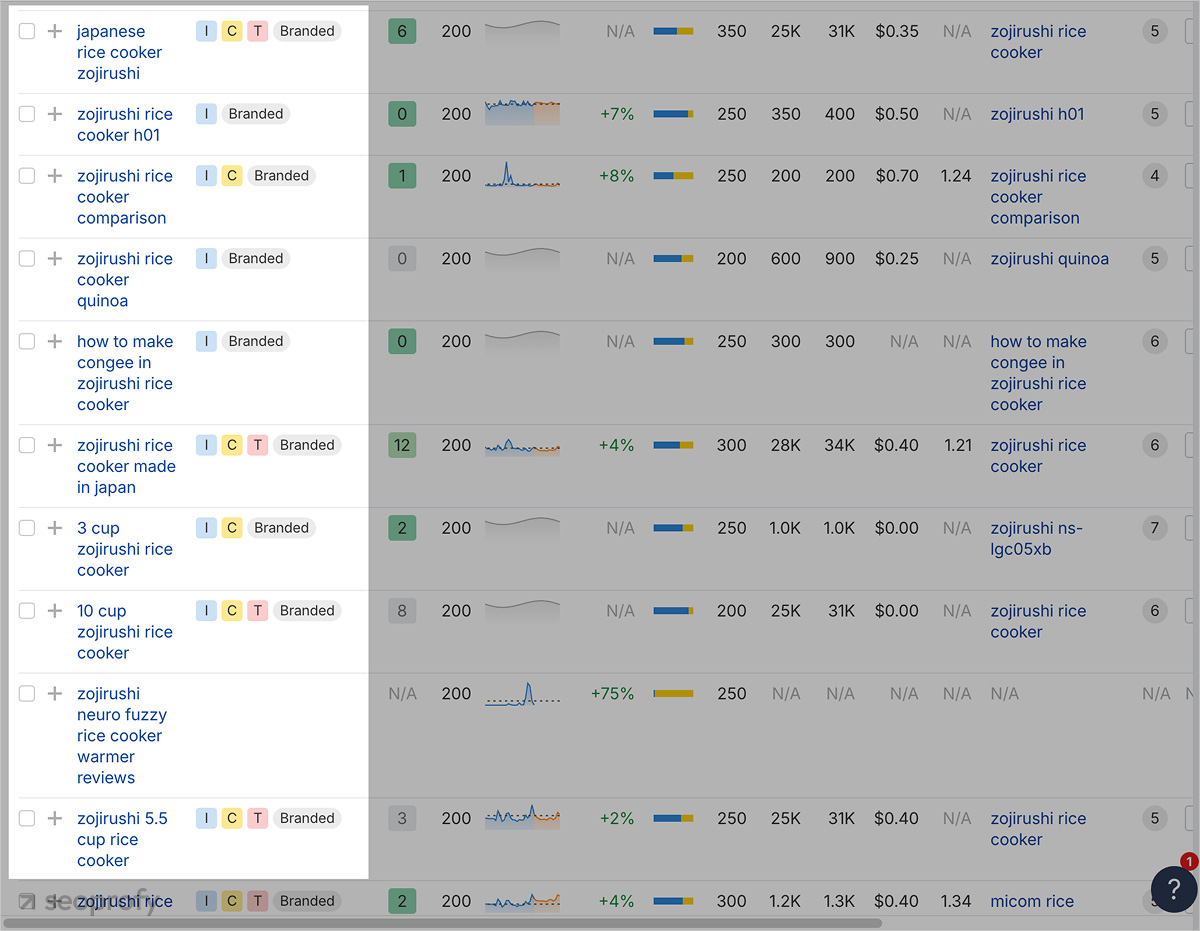
- Keyword research and intent mapping: Research starts with identifying transactional, category-level, comparison, and brand-adjacent queries. These queries are grouped by intent and mapped to the correct page type. Each page targets a clear search task, which prevents overlap and improves relevance.
- Optimizing product pages: Each product page aligns with a specific intent. Titles, headings, descriptions, and specifications reflect how users search, compare, and decide. Variants, availability, pricing context, and use cases appear clearly, so the page answers what the product is, who it’s for, and why it fits the query.
- Optimizing category and collection pages: Category pages target broader commercial intent. They combine structured navigation, concise descriptive copy, and internal links to help users and search engines move from general demand to specific products.
- Improving site structure and internal linking: Clear hierarchy connects categories, subcategories, and products logically. Internal links reinforce topical relevance, surface priority pages, and distribute authority where it matters. Important pages stay close to the homepage.
- Off-page optimization and backlinks: Link building supports key pages and entities, not just the domain. Relevant mentions from guides, reviews, comparisons, and industry content strengthen authority and trust. Context matters more than raw volume.
Pay-Per-Click (PPC) Advertising
PPC is a paid acquisition channel where ecommerce brands buy visibility instead of earning it over time. In practice, this means bidding on keywords, products, or audiences through platforms like Google Ads and paid social networks.
Ads can appear at the top of search engine results pages, inside Google Shopping carousels, across Display and YouTube, and directly in social feeds on Instagram, Facebook, TikTok, or Pinterest. For ecommerce, Shopping ads and remarketing usually play the biggest role because they target users who already show buying intent.
The process itself looks roughly like this:
- You select targets: search queries, product feeds, audiences, or past site visitors.
- You set bids and budgets, manually or through automated strategies.
- The platform runs an auction based on bid size, relevance, expected performance, and quality signals.
- Ads start generating clicks immediately while the campaign is active.
- Performance depends on constant tuning of bids, targeting, creatives, and landing pages.
The biggest advantage of PPC is speed. It attracts customers almost instantly. You don’t need to wait months, as you do with SEO.
The downside is just as clear. PPC traffic is expensive and fragile. The moment you stop paying, traffic disappears. A poorly configured campaign or an exhausted budget can wipe out leads in hours. In many ecommerce niches, cost per click is so high that customer acquisition cost easily climbs above the average order value, making the channel unprofitable for a large share of stores.
Take a simple example:
- Keyword: buy iPhone charger
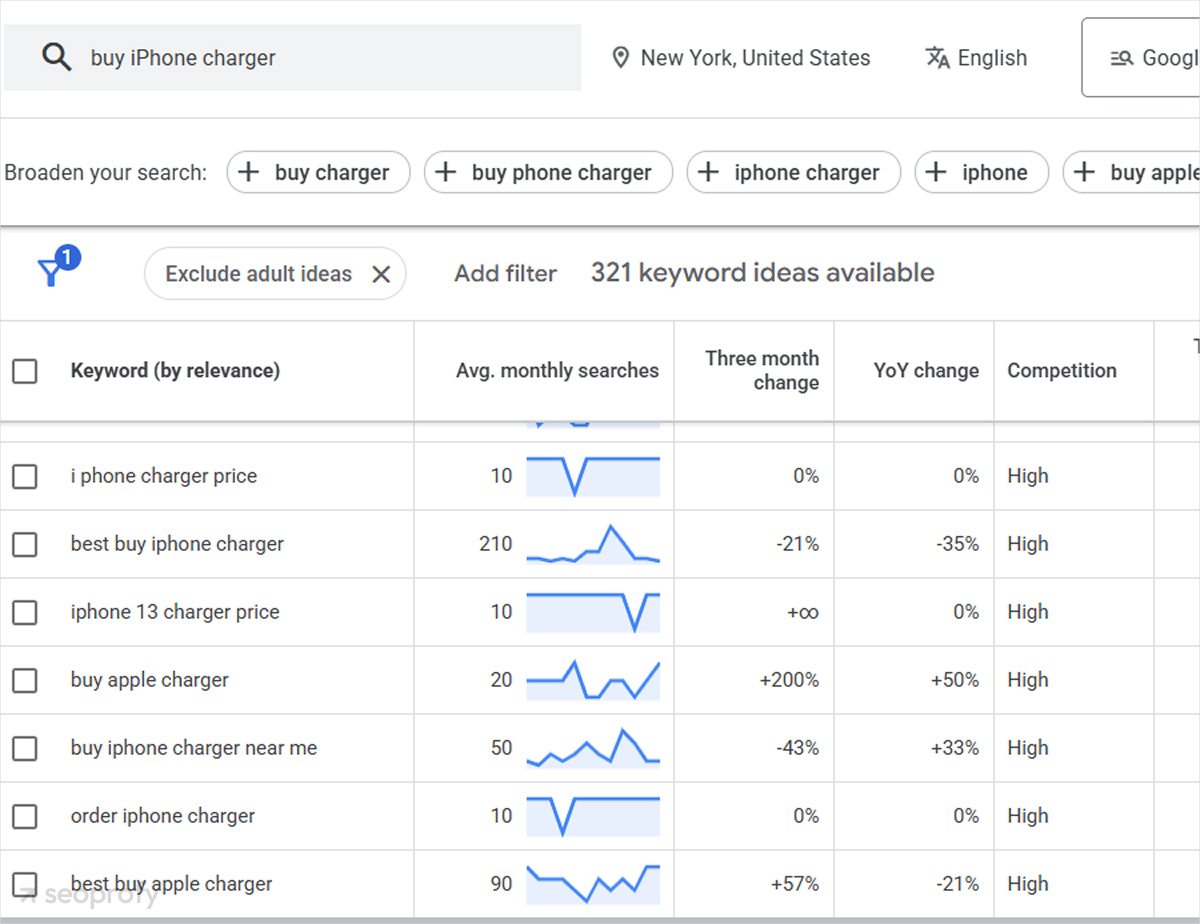
- Google Ads top of page CPC (high range): $4.38
- Average order value: $30
- Conversion rate: 4% (which is already optimistic for cold ecommerce traffic).
Now the math:
- 100 clicks × $4.38 = $438 ad spend
- 4% conversion → 4 purchases
- Revenue: 4 × $30 = $120
- Cost per acquisition (CPA): $727 ÷ 4 = $109.50 per order
Even with a strong 60% gross margin, gross profit equals $72, while acquiring the customer costs $109.50. And this assumes the campaign is configured correctly. In reality, it’s easy to burn an entire budget on non-converting traffic.
On top of that, bidding itself keeps getting more complex. According to our stats, almost 50% of marketers report that PPC campaign management is harder than it was two years ago, driven by higher competition, automation, and thinner margins for error.
At the same time, PPC still has clear use cases. Paid social platforms like Instagram work well where organic reach is limited by design. PPC also makes sense as a launch channel while long-term SEO is building momentum. Remarketing adds another layer by bringing back users who already interacted with products but didn’t convert.
So, used deliberately and combined with other online marketing channels, PPC works as an accelerator. Used alone, it gets expensive very fast.
Social Media Marketing & Social Commerce
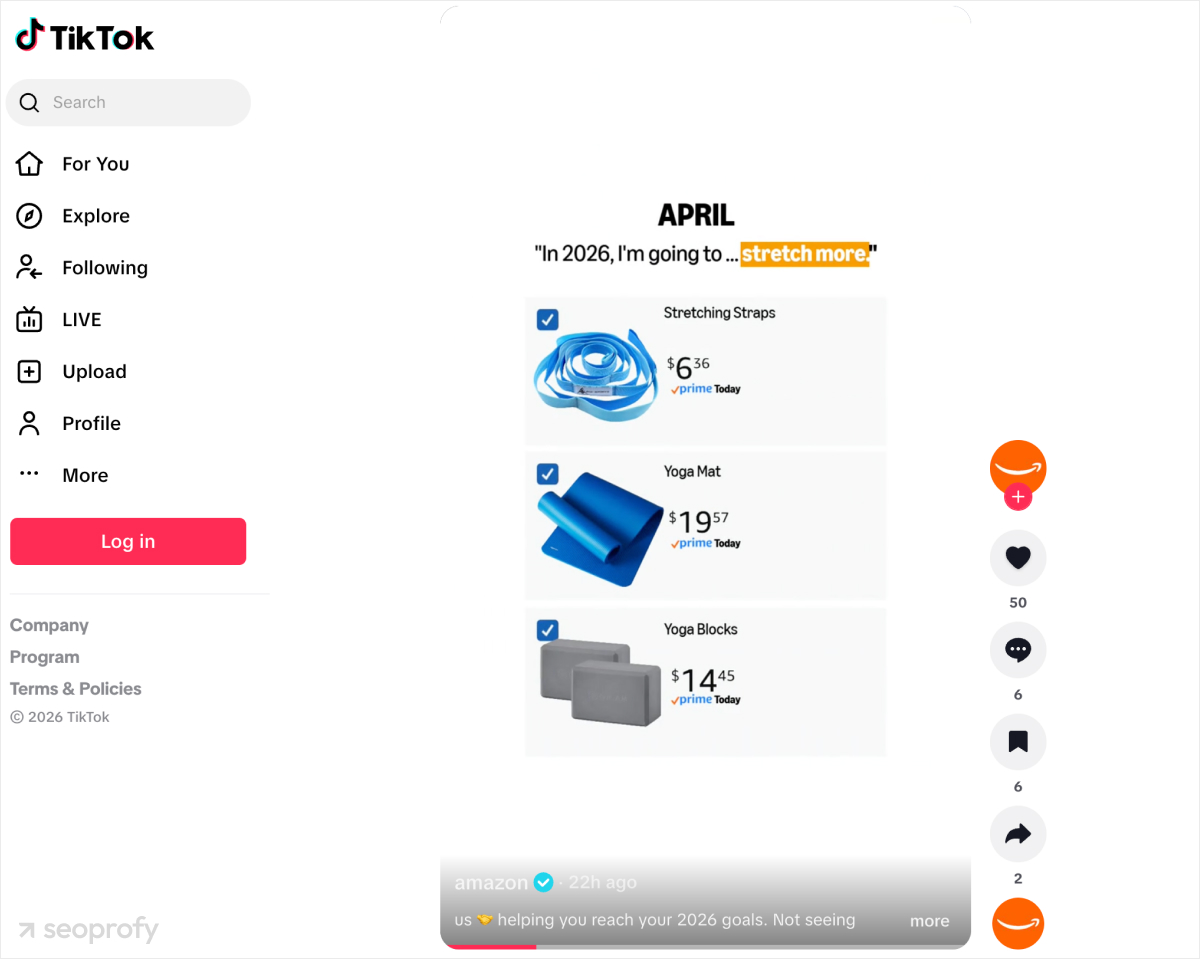
Social media marketing for ecommerce focuses on visibility, demand creation, and direct purchasing inside platforms where users already spend time. It combines organic content, paid distribution, and native shopping features on platforms like Instagram, TikTok, Facebook, and Pinterest. Unlike search, where demand already exists, social media platforms actively create interest, shape preference, and then shorten the path to purchase.
This channel works because it blends content and commerce into a single flow. Brands publish engaging posts, short videos, and Stories that introduce products in a natural, scroll-native format.
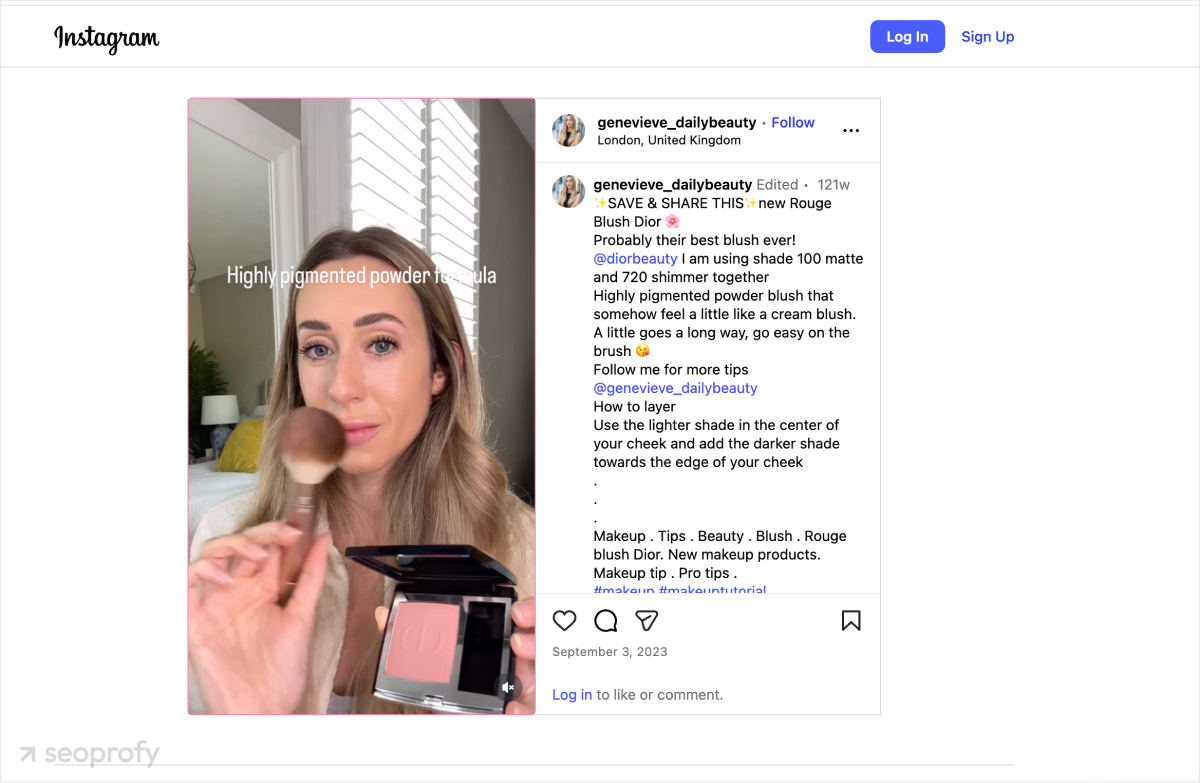
User-generated content plays a central role here. Real reviews, unboxings, tutorials, and customer clips consistently outperform polished brand creatives. In fact, 93% of marketers using UGC say it performs noticeably better than traditional branded content, and 6 out of 10 consumers view this approach as the most authentic type of marketing content.
Social platforms also increasingly function as discovery engines, especially for younger audiences. Research shows that Google usage among Gen Z is roughly 25% lower than among Gen X, and nearly half of Gen Z and over a third of millennials now prefer social platforms over classic search when looking for products or ideas. That shift makes social media not just a branding channel, but a primary entry point into the buying journey.
On the commerce side, platforms now support direct purchasing through native features. Instagram Shopping, TikTok Shop, product tags, and in-feed checkout let users move from discovery to purchase without leaving the app. This removes several traditional steps from the funnel and increases impulse-driven conversions, particularly for visually driven products.
The main strength of social media channels is their ability to build visibility early and influence buying decisions before active search even begins. That visibility often carries over into other channels, improving performance across search, email, and remarketing. However, the results depend heavily on creative quality and ongoing testing.
Content Marketing & Blogging
Content marketing for ecommerce focuses on attracting organic traffic through search and strengthening SEO across the site. Keyword-driven blog posts, guides, and educational content help capture users who research products, compare options, or clarify details before making a purchase.
This channel remains one of the most widely used в digital marketing. Around 70% of marketers rely on content marketing as a primary acquisition and branding channel, and users consistently respond to it better than to direct advertising. Research shows that 70% of internet users prefer learning about a company through its blog content rather than ads, which makes educational content especially valuable for ecommerce brands building trust.
Content works when it is built around real search queries, not abstract topics. Keyword research defines what to publish and how each piece fits into the site structure. Informational articles, buying guides, comparisons, and explainers target specific intents and bring users to the site before they reach product or category pages. Check out how la Roche Posay brand carries that out:

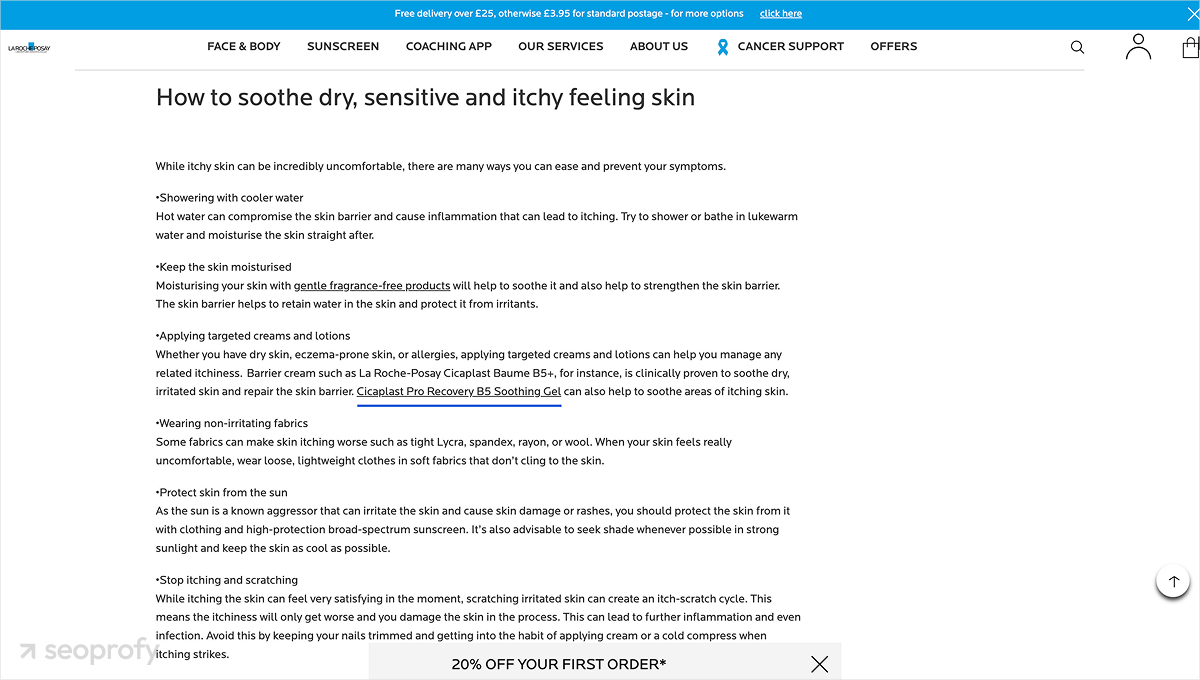
Well-structured content supports SEO in concrete ways. It expands keyword coverage without overloading commercial pages, reinforces topical clusters, and creates internal linking paths that pass relevance and authority to categories and products. Over time, these pages continue generating organic traffic without additional spend.
From an online business perspective, content marketing consistently delivers on core objectives. According to industry research, marketers most often use content to achieve the following goals:
- Increase brand awareness: 87%.
- Generate leads: 74%.
- Nurture and educate their audience: 62%.
Email Marketing
Email marketing for ecommerce works best when you treat it as a system, not a newsletter habit. The core job is simple: build a list you actually own, split it into meaningful groups, then run campaigns and automations that match what each group needs next.
Start with list building that filters for intent. Use dedicated signup offers (first-order incentive, early access, back-in-stock alerts), collect preference signals at signup (product interests, category picks), and add post-purchase opt-ins that feel useful (care tips, replenishment reminders).
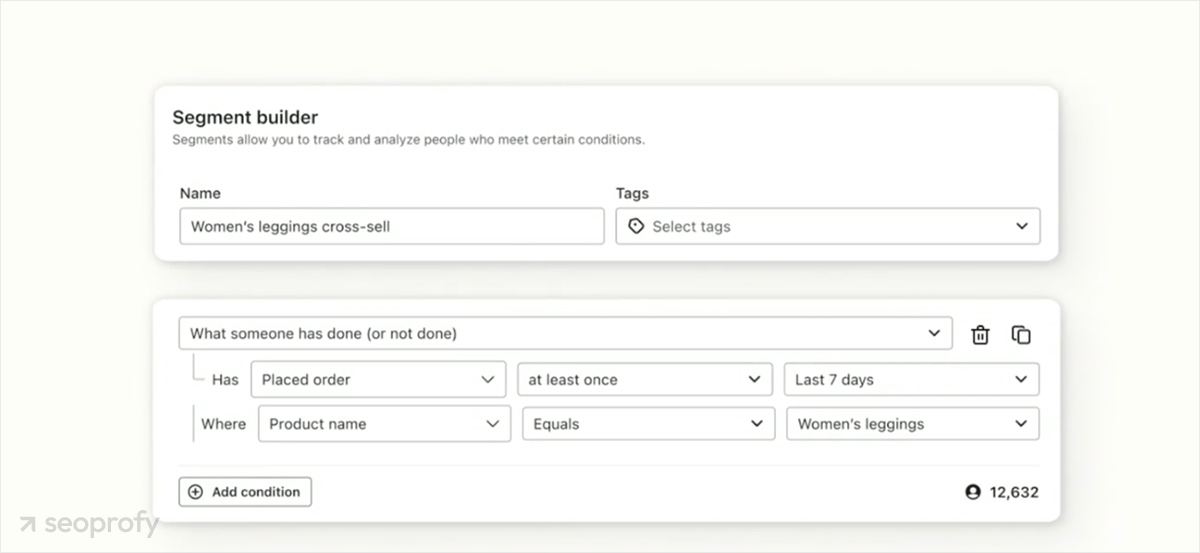
Then segment the list based on behavior and lifecycle, not just demographics: new subscribers, first-time buyers, repeat buyers, high-AOV customers, lapsed customers, category browsers, discount-driven shoppers, and cart abandoners. Here’s how it looks with Klaviyo tool:
Personalization should go beyond “Hi, Hanna.” Use dynamic blocks tied to browsing and purchase history: recently viewed products, category affinity, replenishment timing, size/color preferences, and price sensitivity. Keep the message tight: one primary offer, one clear next step, and a landing page that matches the promise. Most modern ESPs handle this via dynamic content rules and event-based triggers.
Automation is the profit layer. Build sequences that run every day without manual work:
- Welcome series (brand + bestsellers + first purchase nudge)
- Browse abandonment (remind + social proof + light incentive)
- Abandoned cart reminders (timed nudges, escalating only if needed)
- Post-purchase (setup, care, cross-sell, review request)
- Win-back (lapsed customer reactivation with smart offers)
For ecommerce marketing strategies, these flows are usually configured inside Klaviyo, Omnisend, ActiveCampaign, or via ecommerce platforms like Shopify Email, often combined with on-site event tracking and CRM data.
Influencer Partnerships & Loyalty Programs
Influencer partnerships and customer loyalty programs solve two different but related problems in ecommerce: reach and trust on the front end, and repeat revenue on the back end. Used together, they help brands grow faster without relying only on paid traffic.
Influencer marketing works because it “borrows” attention and credibility instead of trying to buy them from scratch. When a product shows up inside a creator’s normal content, it enters the feed as a recommendation, not an ad. That distinction matters for both reach and conversion.
To give a sense of scale, here are a few well-known examples, purely as illustration:
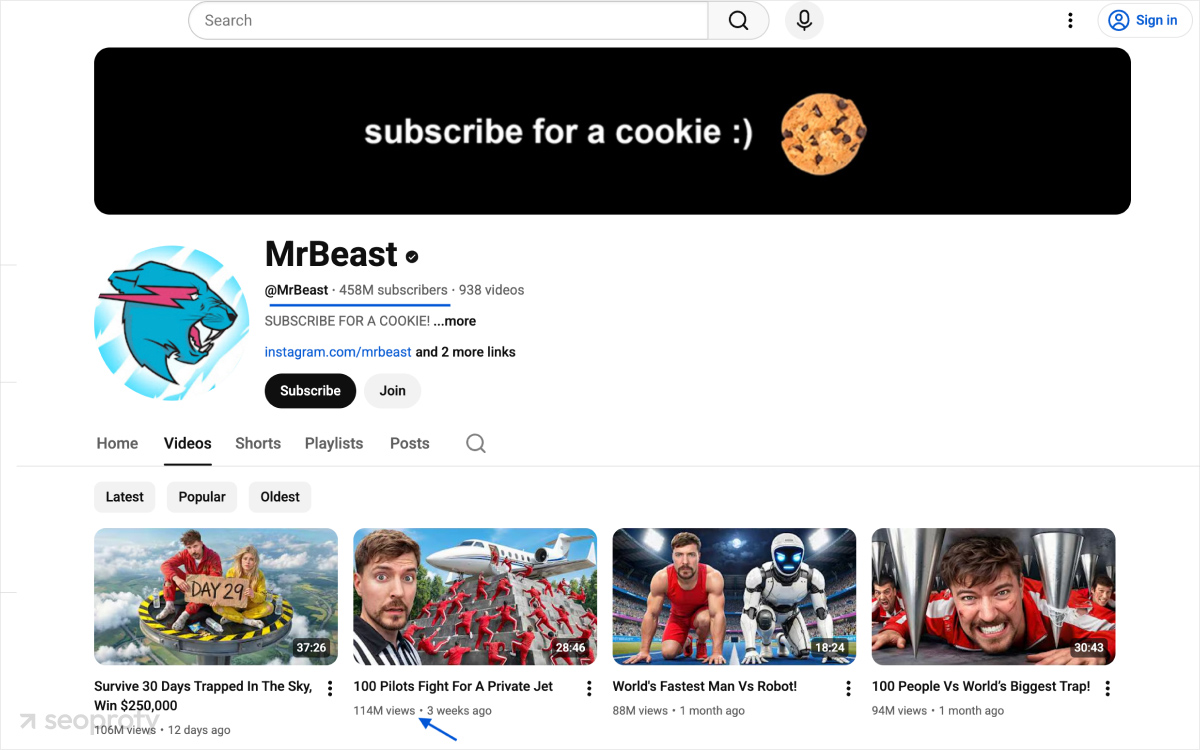
- MrBeast: Audience: 200M+ YouTube subscribers. A single YouTube integration can easily reach 30–50M viewers. Even a 0.1% conversion rate on a $40 product means 30,000–50,000 orders. This level of reach is rare and extremely expensive, but it shows how distribution alone can move revenue.
- Charli D’Amelio: Audience: 150M+ TikTok followers. A product mention inside short-form content can generate millions of impressions in hours. With a 0.3–0.5% click-through rate and modest conversion, brands often see strong spikes in traffic and first-time buyers.

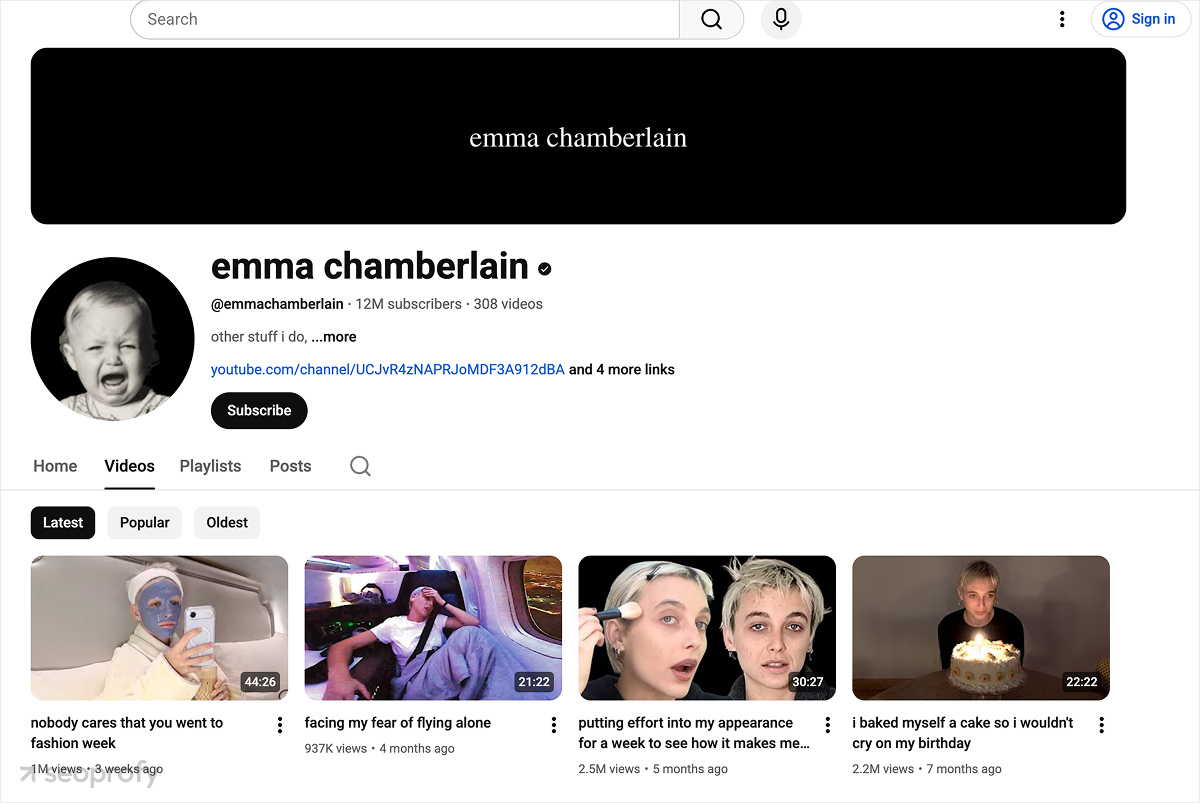
- Emma Chamberlain: Audience: 12M+ YouTube subscribers, strong brand affinity. Smaller reach, but higher trust. These creators often convert better, especially for lifestyle, fashion, and food brands, because the audience expects real usage, not promotion.
Most ecommerce brands don’t work with creators at this scale. In practice, partnerships usually focus on mid-tier and micro-influencers with 50K–500K followers. Their reach is smaller, but engagement is higher, costs are manageable, and content feels more authentic. Multiple smaller creators often outperform one large name in terms of ROI.
Loyalty programs take over after the first purchase. Their goal is to increase repeat orders and lifetime value. Points, tiers, early access, member pricing, and referral bonuses give customers a reason to come back instead of shopping around. Even small lifts in repeat purchase rate have an outsized impact on profitability, especially in ecommerce where acquisition costs keep rising.
Data & Performance Measurement
Data is what keeps ecommerce marketing grounded in reality. Without clear measurement, it’s impossible to know which channels drive growth, which ones just look busy, and where the budget quietly leaks. At the core, ecommerce teams track a small set of KPIs that reflect both acquisition efficiency and revenue quality:
- Traffic: where users come from and how demand distributes across channels.
- Conversion rate (CR): how effectively traffic turns into purchases.
- Average order value (AOV): how much each transaction brings in.
- Customer acquisition cost (CAC): what it costs to acquire a buyer.
- Customer lifetime value (CLV): total revenue a customer generates over time.
- Cart abandonment rate: where and how often users drop out before purchase.
Tracking starts with a clean analytics setup. GA4 usually serves as the foundation, capturing events like product views, add-to-cart actions, checkouts, and purchases. Ecommerce teams then connect analytics to CRM and marketing platforms so user behavior, revenue, and lifecycle data live in one place. This makes it possible to follow a customer from first touch to repeat purchase instead of looking at channels in isolation.
Dashboards pull everything together. Instead of checking each platform separately, teams monitor performance across search, paid media, email, and other channels in a single view. This helps spot trends early, compare efficiency, and understand where growth actually comes from.
In all ecommerce marketing strategies, attribution and testing sit on top of this layer. Tools like ConversionIQ help assign value to different touchpoints and make it clearer how channels contribute to conversions. A/B testing then uses these insights to refine ads, landing pages, email flows, and offers. Each test feeds back into the system and improves performance over time.
Step-by-Step Framework for Success
By this point, you already know the building blocks of an Ecommerce marketing plan and how each channel works. Now comes the real work. Below is a practical, repeatable framework we use to turn all those elements into a working system that drives traffic and, most importantly, sales.
Market & Competitor Research
Start with Google Search Console to identify which queries already generate impressions and clicks, then use GA4 to see how users behave after landing on the site. Add order and revenue data from your ecommerce platform or CRM to understand what actually converts, at which price points, and through which paths.
In parallel, analyze competitors that rank or advertise for the same queries using tools like Ahrefs or Semrush. These platforms help you see which pages competitors use to capture demand, how much visibility they have, and where their traffic comes from.
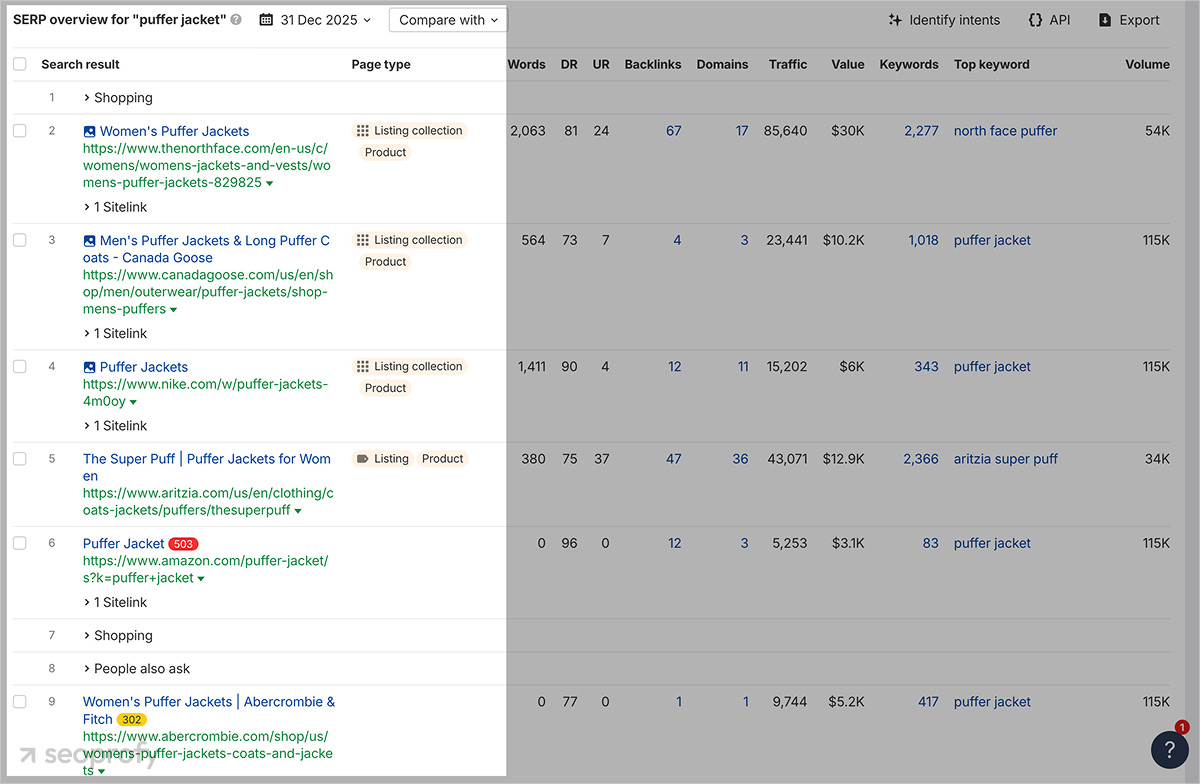
The output of this step is a clear intent and keyword map that shows where demand exists, how it clusters, and where your site can realistically compete. This map is basically the Ecommerce marketing strategies’ foundation for SEO, content, and paid campaigns.
Optimise On-Site Elements & Product Pages
Before you push traffic, the site needs to convert and be technically sound. You start with an audit to spot issues that block performance:
- Crawlability.
- Speed.
- Mobile usability.
- Indexing.
- Structure.
In an online store marketing strategy, product and category pages get special attention. You improve how products are described, how variants and availability are presented, and how pages align with search intent. Internal links reinforce priority pages, and technical SEO removes friction that search engines and users both feel.
Execute Content & Email Marketing
With structure in place, you focus on demand creation and nurturing. Content does the heavy lifting upfront. Email handles follow-up and timing, and together they turn one-time visits into repeat purchases without relying on continuous ad spend.
Here’s your content execution plan:
- Pull your target queries from Google Search Console + Ahrefs/Semrush and group them by intent (informational vs comparison) and by product category.
- Turn that map into a content calendar: each topic gets a target query set, a primary page it should support (category/product), and a clear internal link destination.
- Publish in clusters. Start with the categories that already convert or have the highest margins, so content supports revenue, not just traffic.
- On every article, place internal links deliberately: one link to the most relevant category, one link to a product set, and one link to the next “decision” article (comparison or buying guide).
Email execution:
- Choose your email platform and connect it to your store and GA4.
- Build list entry points that match intent: on-site forms, checkout opt-in, post-purchase opt-in, and content-based signup pages.
- Launch automations first, because they produce results continuously: welcome flow, browse abandonment, abandoned cart, post-purchase, win-back.
Launch Paid & Social Campaigns
For Search and Shopping campaigns, work inside Google Ads and Merchant Center. Start with feed quality, because Shopping performance depends on it directly. Titles, variants, pricing, availability, and identifiers must be accurate. Launch campaigns on best-selling and high-margin products first. Separate branded and non-branded queries, and continuously clean search terms with negatives to prevent budget waste.
For paid social, execution follows a clear sequence:
- Prepare multiple creatives built around different angles: product demo, problem–solution, social proof, bundles, urgency.
- Launch ads across core placements on Instagram and TikTok.
- Use broad or lightly defined audiences initially.
- Retarget site visitors and engaged users with product-specific ads and direct offers.
For influencer campaigns, source creators through platform search, competitor mentions, UGC marketplaces, or tools like Aspire, Grin, CreatorIQ, or Upfluence. Start with small paid collaborations, agree upfront on deliverables and usage rights, and track results through promo codes or tracked links.
Monitor & Refine
The final step never really ends. You track the performance of ecommerce marketing strategies across traffic, conversions, revenue, and customer value. Dashboards surface trends, and attribution shows which channels actually drive results.
As a part of overall ecommerce marketing efforts, you run A/B tests on pages, ads, and emails, then refine based on data. Small improvements compound over time. Campaigns evolve, budgets shift, and the system gets sharper with every iteration.
Grow organic sales without burning ad budgets. Built for stores that need volume, margins, and control.
- Product and category demand mapping
- SEO for AI answers and discovery
- Technical fixes that unblock growth
- Clear ROI and revenue reporting

Conclusion
Ecommerce growth today comes from treating digital marketing as one connected system, not a set of isolated channels. SEO, paid media, content, email, social, and AI-driven discovery work best when they reinforce each other. That is what strong ecommerce marketing strategies look like in practice.
If reading this made you think, “This makes sense, but pulling it off in-house feels heavy,” you are not alone. If you want help turning this into a clear, workable plan, our SeoProfy team is ready to support you with a tailored and successful ecommerce marketing strategy built around results.

As a Content writer at SeoProfy, Hanna Zhytnik creates SEO content grounded in research, data, and ongoing hypothesis testing. With more than 5 years of experience across B2B, SaaS, and ecommerce, she brings both breadth of knowledge and a sharp focus on modern search. Her strength lies in turning complex experiments into clear explanations, bridging the gap between deep SEO practice and accessible content.